

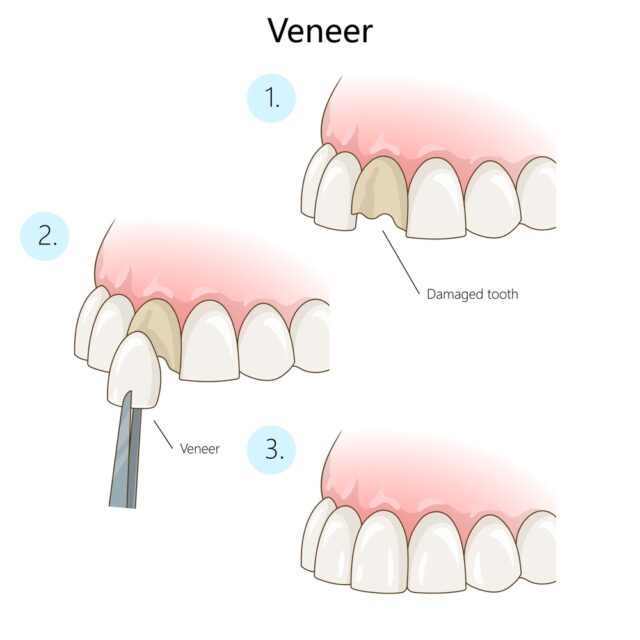
Thin porcelain or composite shells bonded to the front surface of teeth to improve color, shape, size, or minor alignment issues. Minimal tooth reduction required compared to crowns.
Dental Veneers
in Turkey
Dental imperfections can gradually affect confidence, appearance, and self-image over time. Dental veneers have become one of the most popular solutions for patients seeking natural-looking and long-lasting results with minimal tooth alteration.
Turkey is recognized worldwide for advanced dental procedures, experienced specialists, and modern medical facilities. CareBridge US helps international patients access trusted providers while guiding them through every step of the journey from consultation to recovery.
Dental veneer placement is commonly recommended for patients seeking to correct color, shape, or alignment on the front surfaces of healthy teeth. The procedure involves bonding thin layers of ceramic or porcelain onto prepared enamel to create a uniform, natural-looking appearance.
What dental veneers are used for
Dental veneers are used when teeth are healthy but appearance needs adjustment. They do not repair deep structural damage. They only affect the visible surface.
They are commonly used in the following situations:
- permanent tooth discoloration that does not respond to whitening
- small chips or worn enamel edges
- small gaps between teeth
- minor misalignment that does not require orthodontics
- uneven tooth size or shape
In clinical terms, veneers are a conservative restoration. They preserve most of the natural tooth structure while changing its external appearance.
The limitation is important. Veneers do not correct bite problems or severe crowding. They only affect the visible front surface.
Types of dental veneers used in Turkey
Different materials are used depending on function, durability, and tooth position.
E-max veneers are made from lithium disilicate ceramic. They are used mainly in front teeth. They provide a natural light transmission similar to enamel.
Porcelain veneers are widely used for full smile design cases. They offer a balance between durability and appearance.
Zirconia veneers are stronger and more resistant to fracture. They are used in cases with higher bite pressure.
Composite veneers are applied directly on the tooth surface. They require less preparation but have lower durability and stain resistance.
Different materials are used depending on function, durability, and tooth position.
E-max veneers are made from lithium disilicate ceramic. They are used mainly in front teeth. They provide a natural light transmission similar to enamel.
Porcelain veneers are widely used for full smile design cases. They offer a balance between durability and appearance.
Zirconia veneers are stronger and more resistant to fracture. They are used in cases with higher bite pressure.
Composite veneers are applied directly on the tooth surface. They require less preparation but have lower durability and stain resistance.
Material comparison:
- E-max: high aesthetics, moderate strength
- Porcelain: balanced use for full smile cases
- Zirconia: high strength, lower translucency
- Composite: temporary or budget option
Each material is selected based on clinical conditions, not patient preference alone.
- E-max: high aesthetics, moderate strength
- Porcelain: balanced use for full smile cases
- Zirconia: high strength, lower translucency
- Composite: temporary or budget option
Each material is selected based on clinical conditions, not patient preference alone.
Who can receive dental veneers
Not all patients are suitable for veneers. The treatment depends on enamel condition and overall oral health.
Before placement, dentists evaluate whether the tooth can support bonding over time. Enamel thickness is critical because part of it is removed during preparation.
Suitability conditions include:
- healthy teeth without active decay
- stable gum condition without inflammation
- sufficient enamel thickness for bonding
- no untreated periodontal disease
- controlled or absent teeth grinding
If enamel is too thin, bonding may fail over time. If gum disease is present, it must be treated before any cosmetic procedure.
Teeth grinding is a mechanical risk. It does not prevent treatment, but it requires protective measures such as a night guard.
Dental Treatments
Get In Touch With Us
Call Us Anytime
+1 929 7101 505
+90 537 462 26 09
+90 537 462 26 09
Email Us
contact@carebridgeus.com
Book A Free Consultation
Request your free consultation with CareBridge US by filling out the form below. Our team will contact you to discuss your treatment goals and guide you through your medical journey in Turkey.
Dental veneer procedure in Turkey
The dental veneer procedure is performed in multiple stages. It usually takes several days, depending on the number of teeth treated.
The process begins with clinical examination. The dentist evaluates tooth structure, gum condition, and bite alignment. Photographs and digital scans are taken for planning.
After evaluation, treatment planning is done. In many cases, a digital smile design is used to visualize the expected result before starting.
Tooth preparation follows. A thin layer of enamel is removed from the front surface. This step is irreversible. It creates space for the veneer and ensures proper bonding.
Procedure steps:
- clinical examination and digital imaging
- treatment planning and shade selection
- enamel reduction (approx. 0.3–0.7 mm)
- digital scan or physical impression
- placement of temporary veneers
- laboratory fabrication of final veneers
- final bonding and adjustment
The temporary veneers are used while the final ones are being manufactured. They allow basic function and simulate final appearance.
The final veneers are tested for fit, bite, and color before bonding. Dental cement is applied and hardened using a curing light.
Recovery after dental veneers
Recovery after veneer placement is generally short and uncomplicated.
Most patients experience mild sensitivity after treatment. This is related to enamel reduction and temporary nerve exposure. It usually decreases within a few days.
The bite may feel slightly different. This is due to new surface thickness. Adaptation occurs naturally.
Soft food is recommended immediately after bonding. Hard or sticky food is avoided during early adaptation.
Common recovery effects:
- mild temperature sensitivity
- gum adjustment around treated teeth
- temporary bite awareness
- adaptation period of 1–2 weeks
In most cases, normal function returns quickly. Long-term discomfort is not expected if the bite is properly adjusted.
Risks and limitations
Dental veneers are predictable but have permanent structural consequences. Enamel removal cannot be reversed.
The most important limitation is that the tooth is permanently altered. Once enamel is reduced, the tooth will always require coverage.
Possible complications include:
- temporary sensitivity after placement
- chipping under high pressure
- staining of composite veneers
- gum recession exposing margins
- secondary decay at bonding edges
- mechanical failure in cases of grinding
These risks are not immediate. They develop over time depending on oral hygiene and bite forces.
Patients with bruxism have a higher risk of mechanical damage. Protective devices may be required to reduce stress on veneers.
Why dental veneers are performed in Turkey
Dental veneers in Turkey are performed using standard international materials and digital systems. The clinical protocols are similar to those used in Europe.
The main difference is workflow efficiency. Many clinics complete planning, preparation, and fabrication within a short timeframe.
CAD/CAM systems and digital scanning are widely used. This reduces manual error and improves consistency.
Key system features:
- digital smile design planning
- ceramic-based veneer materials (E-max, porcelain, zirconia)
- in-house or fast dental laboratories
- short treatment cycles
- standardized cosmetic protocols
The treatment structure allows completion in a single visit cycle in most cases.
Preparation before treatment
Preparation is focused on oral stability. The goal is to ensure that gums and teeth are in a healthy state before bonding.
Professional cleaning is usually recommended before starting. This reduces inflammation and improves bonding conditions.
Any existing decay or gum disease must be treated first. Veneers cannot be placed over active infection.
Basic preparation steps:
- professional dental cleaning
- treatment of gum disease if present
- stopping smoking when possible
- avoiding whitening after enamel reduction
- full medication disclosure to dentist
Oral hygiene plays a direct role in long-term veneer stability.
Medical evaluation before veneers
A full dental evaluation is required before treatment.
The dentist assesses enamel thickness, tooth alignment, gum health, and bite distribution. Photographs and scans are used for detailed analysis.
Based on findings, treatment is planned. This includes number of veneers, material selection, and expected outcome.
Evaluation criteria:
- enamel condition and thickness
- gum stability
- bite force distribution
- tooth positioning and symmetry
If conditions are not suitable, alternative treatments such as orthodontics or crowns may be recommended.
The decision is based on clinical feasibility, not aesthetics alone.
Before & After
Results
See how dental veneers can help enhance smile aesthetics and correct tooth imperfections through carefully planned cosmetic coordination. Each result depends on the patient’s tooth enamel condition, veneer design, shade matching, bonding precision, and individual adaptation process.
![CareBridge - Cosmetic Dentistry - Before and after [05]](https://carebridgeus.com/wp-content/uploads/2026/05/CareBridge-Cosmetic-Dentistry-Before-and-after-05.jpg "CareBridge - Cosmetic Dentistry - Before and after [05]")
![CareBridge - Cosmetic Dentistry - Before and after [04]](https://carebridgeus.com/wp-content/uploads/2026/05/CareBridge-Cosmetic-Dentistry-Before-and-after-04.jpg "CareBridge - Cosmetic Dentistry - Before and after [04]")
![CareBridge - Cosmetic Dentistry - Before and after [03]](https://carebridgeus.com/wp-content/uploads/2026/05/CareBridge-Cosmetic-Dentistry-Before-and-after-03.jpg "CareBridge - Cosmetic Dentistry - Before and after [03]")
![CareBridge - Cosmetic Dentistry - Before and after [01]](https://carebridgeus.com/wp-content/uploads/2026/05/CareBridge-Cosmetic-Dentistry-Before-and-after-01.jpg "CareBridge - Cosmetic Dentistry - Before and after [01]")
![CareBridge - Cosmetic Dentistry - Before and after [06]](https://carebridgeus.com/wp-content/uploads/2026/05/CareBridge-Cosmetic-Dentistry-Before-and-after-06.jpg "CareBridge - Cosmetic Dentistry - Before and after [06]")
![CareBridge - Cosmetic Dentistry - Before and after [07]](https://carebridgeus.com/wp-content/uploads/2026/05/CareBridge-Cosmetic-Dentistry-Before-and-after-07.jpg "CareBridge - Cosmetic Dentistry - Before and after [07]")
What are veneers?
Porcelain or composite veneers?
Porcelain: more durable (10–15+ years), stain-resistant, more natural appearance, higher cost. Composite: less expensive, single-visit, repairable, but less durable (5–7 years) and more prone to staining.
How much enamel is removed?
Minimal preparation (0.3–0.7 mm) for porcelain veneers—often less than the thickness of a fingernail. Some “no-prep” veneers require no enamel removal. Your dentist preserves maximum healthy tooth structure.
Are veneers reversible?
Traditional porcelain veneers require permanent enamel removal and are not reversible. No-prep options are reversible. Discuss irreversibility before proceeding.
Can I whiten veneers?
No. Porcelain and composite do not respond to bleaching. Choose your desired shade before placement. Plan whitening of natural teeth first, then match veneers to the lighter shade.
How many veneers do I need?
For a full smile transformation, typically 8–10 upper veneers (showing teeth when smiling). Some patients choose 6 for a more conservative approach, or add lower veneers for comprehensive results.
Get Your
Free Consultation
Speak With
A Medical
Consultant
Fill out the form and our team will contact you with personalized guidance and treatment information.
Copyright 2026 by Carebridge US. All rights reserved.
Copyright 2026 by Carebridge US. All rights reserved.