


A titanium screw placed into the jawbone that acts as an artificial tooth root. After osseointegration (3–6 months), a crown, bridge, or denture is attached.
Dental Implants
in Turkey
Tooth loss can gradually affect confidence, appearance, and self-image over time. Dental implants have become one of the most popular solutions for patients seeking natural-looking and long-lasting results with full functional restoration.
Turkey is recognized worldwide for advanced dental procedures, experienced specialists, and modern medical facilities. CareBridge US helps international patients access trusted providers while guiding them through every step of the journey from consultation to recovery.
Dental implant procedure is commonly recommended for patients seeking to replace missing teeth from root to crown. The procedure involves placing a small titanium screw into the jawbone where the tooth root used to be, allowing the bone to fuse around it before attaching an artificial crown on top.
What is a dental implant?
A dental implant replaces the whole tooth, from root to crown. Unlike a bridge that grinds down healthy neighboring teeth, an implant stands alone. It fuses with your bone, a process called osseointegration.
Dentists recommend dental implants in cases like:
- Single missing tooth: The most common case. One implant, one crown.
- Multiple missing teeth: Several implants can support a bridge without touching healthy teeth.
- Complete tooth loss (All-on-4 or All-on-6): Four to six implants hold a full arch of fixed teeth. You never take them out like dentures.
- Failing dentures: Implants can lock dentures in place, stopping them from slipping when you talk or eat.
Who is the best candidate for dental implants in Turkey?
Good candidates meet specific conditions because implant success depends on your body’s ability to heal.
- Good general health: Uncontrolled diabetes, autoimmune diseases, or blood disorders slow healing. Your dentist needs your full medical history.
- Healthy gums: Active gum disease (periodontitis) must be treated first. Placing implants into infected gums almost always fails.
- Enough jawbone density: Your jaw needs to be thick enough to hold the screw. If it is not, you may need a bone graft first. This adds a few months to the timeline.
- Non-smoker status: Smoking kills blood flow to the gums. Heavy smokers have much higher failure rates.
- Realistic expectations: Implants can last 20 years or more with good care, but they are not indestructible. You still need to brush and floss.
If you grind your teeth at night, tell your dentist. You will need a night guard to protect the implants.
Dental implant process in Turkey
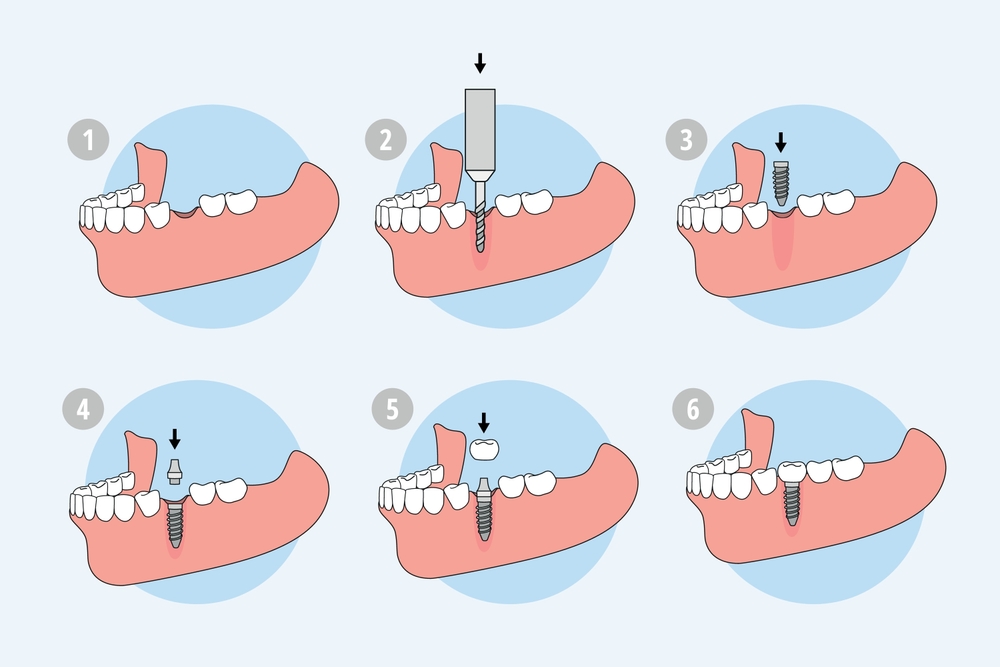
Getting a dental implant is not a single visit. It happens in stages over several months to allow for healing.
- Consultation and planning: X-rays or a CT scan map your jawbone and sinuses. The dentist checks bone density and plans the exact implant position.
- Tooth extraction (if needed): If the damaged tooth is still there, the dentist removes it. Sometimes they place the implant immediately. Other times, you wait for the gum to heal for a few months.
- Bone graft (if needed): If your jawbone is too thin, the dentist adds bone grafting material. You then wait 4 to 6 months for new bone to grow.
- Implant placement: The dentist makes a small cut in your gum to expose the jawbone. They drill a precise hole and gently twist the titanium implant into position.
- Osseointegration (healing phase): You wait 3 to 6 months. During this time, your jawbone grows around the implant, locking it tight.
- Abutment placement: Once the implant is fused, the dentist reopens the gum and attaches a small metal connector called an abutment.
- Crown placement: Finally, they screw or cement the custom-made dental crown onto the abutment. Your new tooth is complete.
The total timeline from start to finish is usually 4 to 9 months. For full-arch restorations like All-on-4, you often leave with a temporary set of teeth on the same day.
Dental Treatments
Get In Touch With Us
Call Us Anytime
+1 929 7101 505
+90 537 462 26 09
+90 537 462 26 09
Email Us
contact@carebridgeus.com
Book A Free Consultation
Request your free consultation with CareBridge US by filling out the form below. Our team will contact you to discuss your treatment goals and guide you through your medical journey in Turkey.
Dental implant recovery
Recovery after implant procedure is usually manageable, but you need to know what is normal.
In the first 2 to 3 days, you will have some swelling, mild bleeding, and bruising around the area. Pain is usually mild to moderate. Over-the-counter painkillers are often enough.
During the first 1 to 2 weeks, you eat soft foods only. No chewing on the implant site. You rinse with salt water but do not spit hard or use a straw (this can dislodge the blood clot).
Osseointegration takes 3 to 6 months. You cannot feel this happening. You just wait. The implant is not under full chewing pressure during this time.
After the final crown is attached, you treat the implant like a real tooth. Brush it. Floss around it. See your dentist for checkups. Neglect is the main reason implants fail years later.
Risks and limitations
Dental implant procedure is safe, but it has risks like any medical procedure. A reputable dentist explains these to you before you start.
Temporary effects you may experience:
- Swelling and bruising: Usually peaks around day 2 and fades within a week.
- Minor bleeding: This is common in the first 24 hours. Bite on gauze.
- Discomfort or throbbing: Manageable with ibuprofen or prescribed medication.
- Numbness or tingling in the lip or chin: If the implant is placed near a nerve. This is usually temporary but can be permanent if the nerve is damaged.
Permanent limitations and serious risks:
- Implant failure (non-osseointegration): The bone simply refuses to fuse to the titanium. More common in smokers and people with uncontrolled health conditions. Happens in about 5% of cases.
- Infection (peri-implantitis): Just like gum disease, but around the implant. This can destroy the bone holding the implant and cause it to loosen. Good oral hygiene prevents it.
- Sinus problems: For implants in the upper jaw, the implant can poke into the sinus cavity. This can cause infections and requires additional procedure to fix.
Long-term maintenance: Implants do not decay, but the gum around them is still vulnerable. You must clean them properly or they will fail like a natural tooth with severe gum disease.
How to prepare for a dental implant in Turkey?
Preparation is mostly about your health. Following these steps reduces complications.
- Stop smoking at least 2 weeks before procedure. Smoking is the number one cause of implant failure. If you cannot stop, be honest with your dentist.
- Tell your dentist about all medications. Blood thinners like warfarin, apixaban, and even high-dose ibuprofen increase bleeding risk.
- Manage your blood sugar. If you have diabetes, your levels must be stable before procedure. High blood sugar prevents healing.
- Get a dental cleaning. Any gum disease or active infection around other teeth must be treated first.
- Arrange for a soft-food supply. You will be eating yogurt, soup, scrambled eggs, and smoothies for the first week.
- Wear comfortable clothes on procedure day. Nothing tight around your neck.
- Do not come alone if you are having sedation. Arrange for someone to stay with you for the first 24 hours.
Medical evaluation for beard transplant in Turkey
A medical evaluation is the point where expectations meet biological reality.
Instead of assumptions, photographs and physical assessment are used to evaluate donor density and facial pattern.
From this, a realistic range of graft availability is determined, along with expected coverage outcomes.
If the case is suitable, planning continues. If not, limitations are explained clearly without adjustment or exaggeration.
The purpose is not approval. The purpose is accuracy.
Before & After
Results
See how dental implants can help restore chewing function and natural-looking tooth replacement through carefully planned surgical coordination. Each result depends on the patient’s bone density, implant positioning, prosthetic design, osseointegration timeline, and individual healing process.
![CareBridge - Cosmetic Dentistry - Before and after [12]](https://carebridgeus.com/wp-content/uploads/2026/05/CareBridge-Cosmetic-Dentistry-Before-and-after-12.jpg "CareBridge - Cosmetic Dentistry - Before and after [12]")
![CareBridge - Cosmetic Dentistry - Before and after [13]](https://carebridgeus.com/wp-content/uploads/2026/05/CareBridge-Cosmetic-Dentistry-Before-and-after-13.jpg "CareBridge - Cosmetic Dentistry - Before and after [13]")
![CareBridge - Cosmetic Dentistry - Before and after [10]](https://carebridgeus.com/wp-content/uploads/2026/05/CareBridge-Cosmetic-Dentistry-Before-and-after-10.jpg "CareBridge - Cosmetic Dentistry - Before and after [10]")
![CareBridge - Cosmetic Dentistry - Before and after [11]](https://carebridgeus.com/wp-content/uploads/2026/05/CareBridge-Cosmetic-Dentistry-Before-and-after-11.jpg "CareBridge - Cosmetic Dentistry - Before and after [11]")
![CareBridge - Cosmetic Dentistry - Before and after [09]](https://carebridgeus.com/wp-content/uploads/2026/05/CareBridge-Cosmetic-Dentistry-Before-and-after-09.jpg "CareBridge - Cosmetic Dentistry - Before and after [09]")
![CareBridge - Cosmetic Dentistry - Before and after [08]](https://carebridgeus.com/wp-content/uploads/2026/05/CareBridge-Cosmetic-Dentistry-Before-and-after-08.jpg "CareBridge - Cosmetic Dentistry - Before and after [08]")
What is a dental implant?
Am I a candidate if I have bone loss?
Mild-to-moderate bone loss can be addressed with bone grafting (sinus lift, ridge augmentation). Severe bone loss may require zygomatic implants or alternative solutions. 3D imaging determines your options.
How long does the full process take?
Immediate load (same-day crown): possible for selected cases with excellent bone. Standard protocol: implant placement, 3–6 months healing, then crown placement. Complex cases with grafting may take 6–12 months.
Do dental implants hurt?
The surgical procedure is performed under local anesthesia—pain-free during placement. Post-operative discomfort is typically mild to moderate, managed with standard pain medication for 3–5 days.
How long do implants last?
With proper oral hygiene and regular dental care, implants can last 20+ years or a lifetime. The crown attached to the implant may need replacement after 10–15 years due to wear.
What is All-on-4 / All-on-6?
Full-arch restoration using 4 or 6 implants to support a fixed prosthetic bridge. Replaces all upper or lower teeth in one procedure, often with immediate temporary teeth.
Get Your
Free Consultation
Speak With
A Medical
Consultant
Fill out the form and our team will contact you with personalized guidance and treatment information.
Copyright 2026 by Carebridge US. All rights reserved.
Copyright 2026 by Carebridge US. All rights reserved.