


Ear cartilage is sufficiently developed by age 5–6, making this an ideal time before school social pressures begin. Adults of any age can also undergo the procedure.
Otoplasty (Ear Correction)
in Turkey
Prominent or asymmetrical ears can gradually affect confidence, appearance, and self-image over time. Otoplasty has become one of the most popular solutions for patients seeking natural-looking and long-lasting results with improved facial balance.
Turkey is recognized worldwide for advanced cosmetic procedures, experienced specialists, and modern medical facilities. CareBridge US helps international patients access trusted providers while guiding them through every step of the journey from consultation to recovery.
Otoplasty (ear correction procedure) is commonly recommended for patients seeking to reshape, reposition, or reduce the size of the ears. The procedure involves reshaping the ear cartilage and using permanent sutures to set the ears closer to the head, creating a more proportionate and balanced facial appearance.
What is otoplasty?
Otoplasty corrects aesthetic and structural ear concerns. Dermatochalasis (redundant skin and cartilage) and steatoblepharon (fat prominence) are not directly applicable to otoplasty. Key indications include:
- Prominent ears (bat ears). Ears that protrude more than 2 cm from the mastoid. Otoplasty can create an antihelical fold and bring the ears closer to the head.
- Asymmetrical ears. Uneven ear shapes, sizes, or projection. Otoplasty improves symmetry and overall facial harmony.
- Macrotia (overly large ears). Ear reduction procedure removes excess cartilage or skin to achieve smaller, more proportionate ears.
- Microtia (underdeveloped ears). Ear augmentation procedure reconstructs the ear shape using the patient’s own cartilage, synthetic implants, or advanced surgical techniques.
- Trauma or injury. Otoplasty can restore damaged ear structures.
- Congenital deformities. Corrects structural abnormalities present from birth.
Operative time ranges from 1 to 2 hours. The procedure is performed under local anesthesia with sedation or general anesthesia.
What are the different otoplasty techniques?
Cartilage-sparing otoplasty (Mustardé and Furnas techniques). The most common approach. It uses permanent sutures (4-0 polypropylene or braided polyester) to create a new antihelical fold or set the ear back. It does not involve cutting or scoring the cartilage. Suture extrusion (5.4%) is the most common complication. Pooled recurrence rate is 2.8%, and revision rate is 2.1%.
Cartilage-suturing (Mustardé–Furnas). Uses Mustardé sutures to create an antihelical fold and Furnas sutures to set the concha back. This combined approach, with modifications, can be applied to almost all prominent ears and has a low risk profile.
Ear pinning (otopexy). Specifically corrects overly protruding ears by reshaping or repositioning cartilage and using sutures to pull the ears closer to the head. The goal is improved symmetry and balance with facial features.
Ear reduction (macrotia correction). Reduces the size of overly large ears by removing excess cartilage or skin. Often used to correct large ear lobes and achieve a more proportionate appearance.
Ear augmentation (microtia correction). Reconstructs underdeveloped ears using the patient’s own rib cartilage, synthetic implants, or advanced surgical techniques. The procedure restores ear structure and improves facial symmetry.
Who is the best candidate for otoplasty?
Candidates have ear shape or position concerns that affect appearance or self-esteem.
- Fully developed ears. Ear growth is complete. This typically occurs by age 5-6.
- No chronic ear infections. Active infections must be resolved before procedure.
- Good general health. No uncontrolled medical conditions that could affect procedure or healing.
- Absence of active skin conditions. Healthy skin around the ears ensures proper healing.
- Realistic expectations. Otoplasty improves ear shape and position but does not create perfect symmetry. Scars are permanent but well hidden.
- Absence of keloid tendency. Patients with a history of keloid scarring may have higher risks.
Contraindications. Active ear infections, untreated bleeding disorders, unrealistic expectations, active skin conditions in the surgical area.
Otoplasty process in Turkey
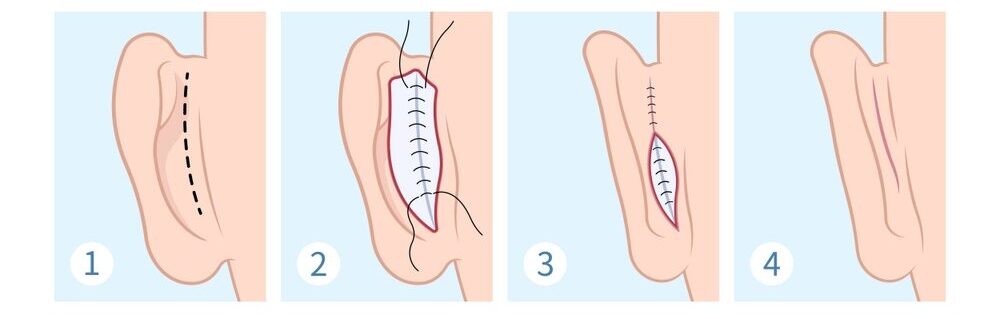
Consultation. Surgeon assesses ear shape, size, and position. Medical history is reviewed. Aesthetic concerns and expectations are discussed. Techniques are explained. Incision placement (postauricular or minimal access) is shown. Near-final results can be previewed manually in the office by bending the ears closer to the head.
Anesthesia. Local anesthesia with sedation or general anesthesia, administered by a specialist anesthesiologist.
Incision placement. For most procedures, incisions are made within the natural creases behind the ear, leaving scars discreet and virtually invisible. For minor adjustments, smaller incisions (minimal access) may be used.
Cartilage reshaping and adjustment. Ear cartilage is repositioned, reshaped, or reduced. For prominent ears, techniques such as cartilage scoring or suturing to pin the ears closer to the head are used.
Symmetry and proportion. Surgeon ensures balanced adjustments to both ears, enhancing overall facial harmony.
Closure. Incisions are closed with fine sutures, often absorbable, to minimize tension and support proper healing.
Dressings and post-surgical care. Protective dressings or bandages and a compression headband are applied to secure the ears in their new position and reduce swelling.
Plastic Surgery Treatments
Get In Touch With Us
Call Us Anytime
+1 929 7101 505
+90 537 462 26 09
+90 537 462 26 09
Email Us
contact@carebridgeus.com
Book A Free Consultation
Request your free consultation with CareBridge US by filling out the form below. Our team will contact you to discuss your treatment goals and guide you through your medical journey in Turkey.
Recovery after otoplasty
Recovery demands adherence to postoperative instructions, particularly wearing the protective headband.
First few days. Swelling, bruising, and mild discomfort around the ears are normal. Protective bandages or a headband keep the ears secure. No pressure on the ears. Sleep with the head elevated.
1 week. Sutures are removed (if non-absorbable). Most patients return to school or sedentary work. A protective headband is worn at night.
2-3 weeks. Most visible swelling resolves. Patients return to social activities. The headband is still worn at night to protect the corrected position.
Month 1-3. Residual swelling and numbness resolve. Scars begin to fade. Avoid contact sports or activities that could traumatize the ears.
Month 6-12. Scars mature, becoming thin and pale. Final results are visible. The corrected ear position is stable unless affected by injury.
Risks and limitations
Common temporary effects. Swelling, bruising, mild discomfort, temporary numbness.
Complications requiring intervention. Suture extrusion (5.4%) is the most common complication; managed with removal in the clinic. Recurrence (2.8%) may require revision. Hematoma (1.3%) may need drainage. Infection (1.3%) is treated with antibiotics. Asymmetry may occur and require revision.
Serious rare complications. Skin necrosis (rare), keloid formation (rare in patients without predisposition), chronic pain, permanent nerve injury.
Permanent limitations. Scars are permanent but well hidden. Some asymmetry may persist. There is a low risk of recurrence (2.8%) in the long term. The procedure does not stop the aging process; gradual relaxation may occur over decades.
Otoplasty has a high satisfaction rate (over 95%). Serious complications occur in less than 3% of cases.
How to prepare for otoplasty in Turkey
Preoperative medical preparation.
- Discontinue smoking at least four weeks before procedure. Nicotine significantly impairs wound healing and increases necrosis risk.
- Stop blood-thinning agents (aspirin, ibuprofen, warfarin, clopidogrel, fish oil, vitamin E) as directed.
- Complete preoperative laboratory tests (complete blood count, coagulation profile, chemistry panel).
- Treat any active ear infections or skin conditions.
- Achieve stable blood pressure and blood glucose if diabetic.
- Have a dental check-up to rule out any active infection.
Logistical preparation. Plan to stay in Turkey for 7-10 days. Early suture removal at 5-7 days is standard. Pack front-fastening, loose-fitting tops; garments that pull over the head are not suitable for the first week. Bring a protective headband if not provided.
Before & After
Results
See how otoplasty can help reposition prominent ears and improve facial balance through carefully planned treatment coordination. Each result depends on the patient’s ear cartilage structure, degree of protrusion, surgical technique, and individual healing process.
![CareBridge - Autoplasty - Before and after [01]](https://carebridgeus.com/wp-content/uploads/2026/05/CareBridge-Autoplasty-Before-and-after-01.jpg "CareBridge - Autoplasty - Before and after [01]")
![CareBridge - Autoplasty - Before and after [03]](https://carebridgeus.com/wp-content/uploads/2026/05/CareBridge-Autoplasty-Before-and-after-03.jpg "CareBridge - Autoplasty - Before and after [03]")
![CareBridge - Autoplasty - Before and after [05]](https://carebridgeus.com/wp-content/uploads/2026/05/CareBridge-Autoplasty-Before-and-after-05.jpg "CareBridge - Autoplasty - Before and after [05]")
![CareBridge - Autoplasty - Before and after [04]](https://carebridgeus.com/wp-content/uploads/2026/05/CareBridge-Autoplasty-Before-and-after-04.jpg "CareBridge - Autoplasty - Before and after [04]")
![CareBridge - Autoplasty - Before and after [02]](https://carebridgeus.com/wp-content/uploads/2026/05/CareBridge-Autoplasty-Before-and-after-02.jpg "CareBridge - Autoplasty - Before and after [02]")
At what age can otoplasty be performed?
Where are the incisions?
Hidden behind the ear in the natural crease. No visible front scarring.
Is the result permanent?
Yes, the cartilage is reshaped and secured with internal sutures. Recurrence is rare but can occur if sutures loosen or cartilage “memory” causes partial relapse.
How long do I wear the headband?
A protective headband is worn continuously for 1–2 weeks, then at night for 4–6 weeks to protect ears during sleep.
Will both ears look exactly the same?
Perfect symmetry is neither achievable nor natural. The goal is normal, balanced appearance. Slight differences between ears are normal and expected.
Get Your
Free Consultation
Speak With
A Medical
Consultant
Fill out the form and our team will contact you with personalized guidance and treatment information.
Copyright 2026 by Carebridge US. All rights reserved.
Copyright 2026 by Carebridge US. All rights reserved.