


Hormonal imbalance, certain medications (steroids, anti-androgens, some antidepressants), marijuana use, obesity, or idiopathic (unknown cause). True gynecomastia involves glandular tissue; pseudogynecomastia is fat alone.
Gynecomastia Procedure
in Turkey
Enlarged male breast tissue can gradually affect confidence, appearance, and self-image over time. Gynecomastia procedure has become one of the most popular solutions for patients seeking natural-looking and long-lasting results with a flatter, more masculine chest.
Turkey is recognized worldwide for advanced cosmetic procedures, experienced specialists, and modern medical facilities. CareBridge US helps international patients access trusted providers while guiding them through every step of the journey from consultation to recovery.
Gynecomastia procedure (male breast reduction) is commonly recommended for patients seeking to remove excess glandular tissue and fat from the chest. The procedure typically combines liposuction with direct glandular excision through a small peri-areolar incision to restore a defined, masculine chest contour.
What is gynecomastia?
Patients seek gynecomastia treatment when conservative measures have failed. The breast tissue does not respond to lifestyle modifications or hormonal therapy.
Doctors classify male breast enlargement using the Simon grading system, which guides treatment planning:
Grade 1: Visible breast enlargement without redundant skin
Grade 2A: Moderate breast enlargement without skin redundancy
Grade 2B: Moderate enlargement with minor redundant skin
Grade 3: Gross enlargement with skin redundancy and breast ptosis (sagging)
A distinction must be made between gynecomastia and pseudogynecomastia:
True gynecomastia: Enlargement caused by glandular proliferation. Examination reveals a firm, rubbery disk under the nipple. Glandular tissue is dense and fibrous; liposuction alone cannot remove it. Surgical excision of the gland is required.
Pseudogynecomastia: Enlargement caused by increased fat deposition without glandular growth. The chest feels soft and diffuse. Liposuction alone is sufficient.
The “puffy nipple” variant presents with localized sub‑areolar glandular hypertrophy. The chest may otherwise appear normal, but the nipple‑areola complex protrudes in a cone shape. Targeted gland excision through a small peri‑areolar incision flattens the nipple while preserving blood flow and sensation.
Who is the best candidate for gynecomastia procedure in Turkey?
Suitable candidates meet specific clinical criteria that optimize outcomes and minimize complications.
Physical maturity: Treatment is generally deferred until after puberty, typically age 18‑21. Pubertal gynecomastia spontaneously resolves in 70‑90% of cases within 12‑24 months. Waiting past this window is recommended.
Stable weight for at least 6‑12 months. The condition should be stable. Future weight fluctuations can alter chest contour regardless of treatment results. Some UK guidelines require BMI maintained at 27 or lower.
Palpable glandular tissue confirmed. Physical examination reveals a discrete, firm sub‑areolar disk measuring 2 cm or more in diameter. Ultrasound may be used for confirmation.
Not primarily obese. The procedure is not a weight loss method. Men with a BMI above 30 are not good candidates. Significant weight loss should be achieved and maintained prior to the procedure.
Non‑smoker or willing to cease smoking for at least 4 weeks prior to the procedure. Nicotine causes vasoconstriction and dramatically impairs wound healing, increasing risk of skin necrosis and poor scarring.
No uncontrolled medical conditions. Diabetes, bleeding disorders, and untreated hormonal imbalances must be optimally managed before the procedure.
Absolute contraindications: Active breast cancer (requires oncologic workup first). Untreated hyperprolactinemia or testicular tumors (address underlying cause before considering procedure). Active infection or severe uncontrolled systemic disease.
Gynecomastia procedure process in Turkey
The procedure is performed in a hospital operating room under general anesthesia. Inpatient stay is typically one night.
Consultation and marking: Preoperative evaluation includes history, physical examination, and confirmation of diagnosis. The surgeon assesses gland size, fat distribution, skin elasticity, and degree of ptosis. Preoperative photographs are obtained. The patient is marked while standing: the borders of the glandular disc, areas of lipodystrophy, and the planned incision locations. The neo‑nipple position is marked with the patient standing.
Anesthesia. General anesthesia administered by a specialist anesthesiologist. Operative time ranges from 1.5 to 3 hours depending on case complexity.
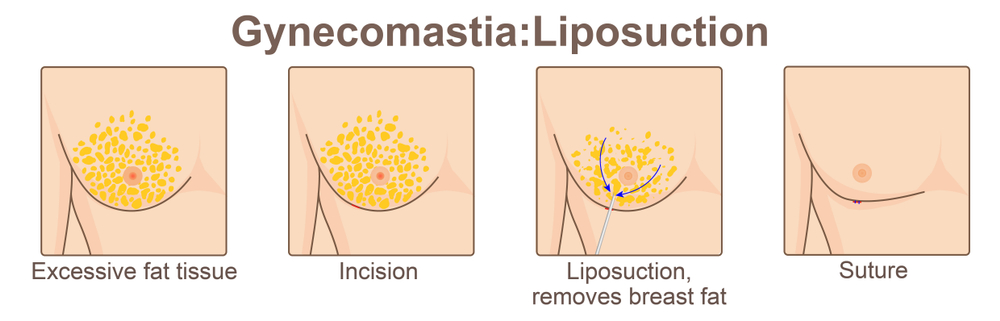
Liposuction (first stage). For fatty components and peripheral feathering, tumescent liposuction is performed through small stab incisions (2‑3 mm) placed in the axilla or along the lateral chest wall. This debulks the breast and creates a smooth transition from the chest wall to the surrounding areas. Ultrasonic‑assisted liposuction (VASER) may be used to enhance fat removal and promote skin contraction.
Glandular excision (second stage). The firm retro‑areolar glandular disc, which liposuction cannot remove, is excised directly. An incision is made along the lower half of the areolar border (peri‑areolar incision, approximately 2‑3 cm). The surgeon dissects through the subcutaneous tissue, identifies the glandular plate, and carefully removes it using sharp dissection or electrocautery. Care is taken to preserve the vascular supply to the nipple‑areola complex. For severe cases (Grade 2B and Grade 3), the GLAND‑IQ technique combines liposuction, glandular excision, circumareolar mastopexy (for areolar reduction and skin envelope redraping), and internal quilting sutures to eliminate dead space. This approach achieves significant skin and nipple reduction without visible extra‑areolar scars.
Closure and drainage. Meticulous hemostasis is achieved. Layered closure with absorbable sutures is performed. A drain may be placed for 24‑48 hours in cases of significant resection. Sterile dressings and a compression garment are applied.
Plastic Surgery Treatments
Get In Touch With Us
Call Us Anytime
+1 929 7101 505
+90 537 462 26 09
+90 537 462 26 09
Email Us
contact@carebridgeus.com
Book A Free Consultation
Request your free consultation with CareBridge US by filling out the form below. Our team will contact you to discuss your treatment goals and guide you through your medical journey in Turkey.
Recovery after gynecomastia procedure
Recovery follows a predictable timeline. Final chest contour appears gradually over 3‑6 months.
Hospital stay (1 night). The patient is monitored for immediate complications. Pain is managed with oral analgesics. Drains, if placed, are typically removed before discharge.
Week 1 to 2. The compression vest is worn 24 hours per day. Swelling and ecchymosis (bruising) peak during the first 72 hours then gradually subside. Moderate discomfort is well‑controlled with oral medication. Arm movement is restricted below shoulder height. Heavy lifting and strenuous activity are prohibited. Most patients with desk jobs return to work at 3‑7 days.
Week 3 to 4. Swelling and bruising decrease significantly. The compression vest is continued (most protocols require 3‑4 weeks of full‑time wear, some up to 6 weeks). Light activities resume. No upper body exercise or lifting over 5 kg.
Week 6 to 8. Gradual return to normal exercise, including jogging, cycling, and moderate gym work. High‑intensity chest exercises (bench press, push‑ups) are typically cleared after 6 weeks.
Month 3 to 6. The majority of swelling resolves. The chest contour becomes defined. Scar maturation progresses from red to pink. Full healing and final results are typically visible by 6 months.
Month 12. Scars continue to fade, becoming thin and pale. Complete soft‑tissue settling and sensory recovery may take up to 12‑18 months.
Risks and limitations
Gynecomastia procedure carries a 1‑3% risk of complications. The vast majority of patients experience an uncomplicated recovery.
Common temporary effects. Pain, edema, and ecchymosis. Numbness of the nipple‑areola complex and surrounding skin (temporary, resolves over 6‑12 months). Firmness or nodularity in the treatment bed, which resolves with time and massage.
Possible complications requiring intervention. Hematoma (1‑3%) may require drainage. Seroma (1‑5%) is managed with aspiration. Infection (1.3%) is treated with antibiotics. Wound dehiscence (partial incision separation) may occur, more commonly at the peri‑areolar incision site. Asymmetry may be addressed with revision procedure after 6 months.
Serious but rare complications. Nipple‑areola complex necrosis (under 1%) occurs more frequently in smokers and patients requiring extensive resection or free nipple grafting. Venous thromboembolism is prevented by early ambulation and mechanical prophylaxis. Anesthesia complications.
Permanent limitations. Visible scarring is permanent but easily concealed by chest hair and pectoral contour. Nipple sensation may be permanently altered in a minority of patients. The glandular tissue that has been removed does not grow back. However, if the patient gains significant body weight after the procedure, the remaining fat cells in the chest can enlarge, leading to a recurrence of fullness.
How to prepare for gynecomastia procedure in Turkey
Preoperative medical preparation.
Discontinue smoking at least four weeks before the procedure. Nicotine cessation is mandatory. Postpone the procedure if cessation is not possible.
Stop blood‑thinning medications (aspirin, ibuprofen, warfarin, clopidogrel, fish oil, vitamin E) as directed by the surgeon.
Complete preoperative laboratory tests (complete blood count, coagulation profile, chemistry panel, and hormone panel if indicated).
Achieve and maintain a stable, healthy body weight for 6‑12 months before the procedure.
Obtain medical clearance for any chronic conditions.
Have a preoperative chest ultrasound if ordered to confirm the presence of glandular tissue.
Logistical preparation.
Plan a stay in Turkey of 7‑10 days.
Do not travel alone for the first 24‑48 hours. Assistance with daily activities will be necessary.
Pack front‑fastening, loose‑fitting shirts and zip‑up hoodies. Garments that pull over the head are not suitable.
Purchase an extra compression vest if the clinic provides only one. The garment will be worn continuously for 3‑4 weeks.
Before & After
Results
See how male breast reduction can help create a flatter, more masculine chest contour through carefully planned tissue removal coordination. Each result depends on the patient’s tissue composition (glandular vs. fatty), skin elasticity, extent of correction, and individual healing process.
![CareBridge - Gynecomastia - Before and after [04]](https://carebridgeus.com/wp-content/uploads/2026/05/CareBridge-Gynecomastia-Before-and-after-04.jpg "CareBridge - Gynecomastia - Before and after [04]")
![CareBridge - Gynecomastia - Before and after [03]](https://carebridgeus.com/wp-content/uploads/2026/05/CareBridge-Gynecomastia-Before-and-after-03.jpg "CareBridge - Gynecomastia - Before and after [03]")
![CareBridge - Gynecomastia - Before and after [02]](https://carebridgeus.com/wp-content/uploads/2026/05/CareBridge-Gynecomastia-Before-and-after-02.jpg "CareBridge - Gynecomastia - Before and after [02]")
![CareBridge - Gynecomastia - Before and after [01]](https://carebridgeus.com/wp-content/uploads/2026/05/CareBridge-Gynecomastia-Before-and-after-01.jpg "CareBridge - Gynecomastia - Before and after [01]")
What causes gynecomastia?
How is it treated?
Liposuction for fatty tissue. Surgical excision through a periareolar incision for glandular tissue. Skin excision for significant skin excess. Most cases combine techniques.
Will I have a scar?
Liposuction-only cases have tiny, nearly invisible scars. Glandular excision requires a semicircular scar around part of the areola, which typically heals well and is discreet.
Can gynecomastia recur?
If underlying causes (hormonal issues, medications, weight gain) persist, recurrence is possible. Addressing root causes and maintaining stable weight prevents return.
How soon can I go shirtless after surgery?
Compression garments are worn for 4–6 weeks. Most patients feel comfortable going shirtless socially by 6–8 weeks once swelling and bruising resolve.
Get Your
Free Consultation
Speak With
A Medical
Consultant
Fill out the form and our team will contact you with personalized guidance and treatment information.
Copyright 2026 by Carebridge US. All rights reserved.
Copyright 2026 by Carebridge US. All rights reserved.