


Typically the scalp (back of head). Scalp hair is finer than native beard hair but blends well when properly angled. Body hair (chest) is occasionally used as secondary donor source.
Beard Transplant
in Turkey
Hair loss can gradually affect confidence, appearance, and self-image over time. A beard transplant has become one of the most popular solutions for patients seeking natural-looking and long-lasting results with minimal visible scarring.
Turkey is recognized worldwide for advanced hair transplant procedures, experienced specialists, and modern medical facilities.
CareBridge US helps international patients access trusted providers while guiding them through every step of the journey from consultation to recovery.
Beard transplant is a variation of FUE (Follicular Unit Extraction) commonly recommended for patients seeking wider coverage and natural-looking density in facial areas. The procedure involves extracting individual hair follicles from donor areas and implanting them into beard, mustache, or sideburn regions affected by patchiness, scarring, or incomplete natural growth.
What is beard transplant
A beard transplant is a variation of FUE hair restoration, adapted specifically for facial hair.
Follicles are extracted one by one from the back and sides of the scalp, where hair is genetically resistant to thinning. These grafts are then placed into the beard, mustache, or sideburn area depending on the design.
What makes the procedure more complex than scalp work is not extraction, but direction. Beard hair does not grow in a single pattern. It changes angle across the jaw, becomes softer near the cheeks, and denser around the chin. If placement ignores this, the result looks unnatural even if the hair grows successfully.
The procedure is commonly used for patchiness, scarring, or simply to increase overall density when genetics never fully supported beard growth.
The donor area remains the limiting factor in every case. Nothing changes that.
Who is a good candidate for beard transplant in Turkey
Not every case of sparse facial hair is suitable for intervention. Some patterns are still evolving naturally, while others are biologically stable.
The most important factor is the donor area. The scalp must have enough strong follicles that can be safely removed without visible thinning afterward.
Facial skin must also be stable. Even mild inflammation or active acne can interfere with graft survival during early healing.
There is also timing. Beard growth often continues into early adulthood, so intervention too early can interrupt a natural process that would have improved on its own.
In most suitable cases:
- facial hair growth has remained stable for a long period
- donor area shows strong and even density
- skin is healthy without ongoing inflammation
- expectations are aligned with realistic density limits
- no active dermatological conditions are present
Age matters less than stability. A stable pattern always produces more predictable results than a developing one.
Beard transplant process in Turkey
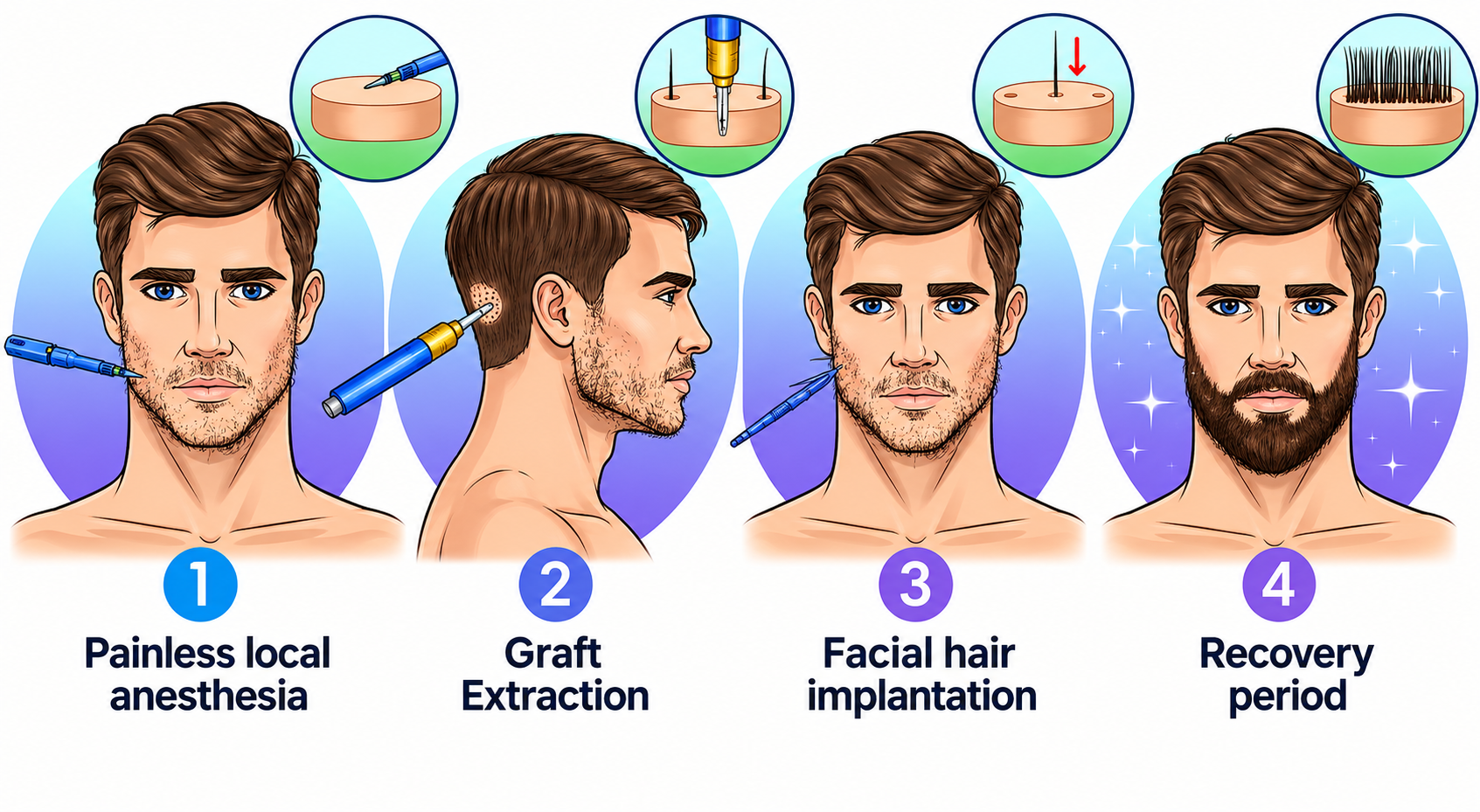
The beard transplant process in Turkey does not feel like a sequence of separate technical stages when experienced in reality. It is more of a continuous workflow where each decision affects the next.
It usually begins with observation and design. The face is studied under natural proportions, and the beard shape is mapped based on symmetry and density zones. Some areas require sharper definition, while others need softer blending to avoid an artificial outline.
Once the design is agreed, the scalp is prepared. Local anesthesia is applied, and the donor area becomes numb.
Follicles are then carefully extracted one at a time. Each graft is preserved in a solution that keeps it viable during the session.
After that, attention shifts to the face. Tiny channels are created where each follicle will be placed. This is where most of the visual outcome is actually determined, even though it is invisible during the procedure.
Implantation follows naturally, with each graft positioned according to direction, angle, and density planning.
Nothing about this phase is rushed, because small differences in placement later define how natural the beard looks.
The session usually lasts several hours depending on the number of grafts needed. Full beard cases require a significantly larger graft count than localized corrections.
Hair Loss Treatments
Get In Touch With Us
Call Us Anytime
+1 929 7101 505
+90 537 462 26 09
+90 537 462 26 09
Email Us
contact@carebridgeus.com
Book A Free Consultation
Request your free consultation with CareBridge US by filling out the form below. Our team will contact you to discuss your treatment goals and guide you through your medical journey in Turkey.
Beard transplant recovery
Recovery does not reveal results immediately. In fact, the early phase can feel underwhelming if expectations are not explained clearly.
The first few days are mostly about skin response. Slight redness and small scabs appear in the treated areas. This is normal tissue reaction and fades gradually.
Shortly after, the transplanted hairs begin to shed. This is often misunderstood, but it is a standard part of the follicle cycle. The roots remain in place even when the visible hair falls out.
Around month three, new growth starts to appear. It is thin and soft at first, almost uneven in texture.
By month six, the beard begins to take shape. Density improves, and coverage becomes more visible in daily light rather than controlled conditions.
Full maturation takes time. Usually between 12 and 18 months, the final texture, thickness, and direction settle into a permanent pattern.
There is no shortcut in this biological process. Growth follows its own timeline regardless of technique.
Risks and limitations
Every beard transplant is bound by biological constraints, no matter how refined the technique becomes.
Some effects are temporary and expected during healing. These include swelling, redness, sensitivity, and shedding of transplanted hairs in the early phase.
More important are the structural limits that define the final outcome.
- Donor supply limits maximum density.
- Ongoing hair loss may continue in untreated scalp areas.
- Hair thickness cannot be changed through transplantation.
- Small white dot scarring remains in the donor zone.
- Early uneven growth may appear before full maturation.
These are not complications. They are the natural boundaries of the procedure.
A realistic result depends less on technique and more on how well these limits are understood before starting.
How to prepare for beard transplant
Preparation is less about complexity and more about consistency.
The scalp and facial skin need to be in a stable condition before the procedure begins. Smoking and alcohol are usually stopped in advance because they directly affect circulation and healing response.
Any medication that influences blood flow must be reviewed medically before the procedure.
On the day itself, simplicity is important. The skin should be clean, free from products, and not recently shaved unless instructed otherwise.
Preparation usually includes:
- stopping smoking and alcohol in advance
- reviewing medication with a doctor
- keeping skin clean and untreated
- avoiding shaving unless advised
- wearing comfortable clothing
The first 24 hours after implantation are particularly important for graft stability and early survival.
Medical evaluation for beard transplant in Turkey
A medical evaluation is the point where expectations meet biological reality.
Instead of assumptions, photographs and physical assessment are used to evaluate donor density and facial pattern.
From this, a realistic range of graft availability is determined, along with expected coverage outcomes.
If the case is suitable, planning continues. If not, limitations are explained clearly without adjustment or exaggeration.
The purpose is not approval. The purpose is accuracy.
Before & After
Results
See how facial hair transplantation can help restore or enhance beard and moustache density and define facial framing through carefully planned graft placement coordination. Each result depends on the patient’s donor hair characteristics, facial structure, desired design, and individual healing process.
![CareBridge - Beard Transplant - Before and after [04]](https://carebridgeus.com/wp-content/uploads/2026/05/CareBridge-Beard-Transplant-Before-and-after-04.jpg "CareBridge - Beard Transplant - Before and after [04]")
![CareBridge - Beard Transplant - Before and after [03]](https://carebridgeus.com/wp-content/uploads/2026/05/CareBridge-Beard-Transplant-Before-and-after-03.jpg "CareBridge - Beard Transplant - Before and after [03]")
![CareBridge - Beard Transplant - Before and after [02]](https://carebridgeus.com/wp-content/uploads/2026/05/CareBridge-Beard-Transplant-Before-and-after-02.jpg "CareBridge - Beard Transplant - Before and after [02]")
![CareBridge - Beard Transplant - Before and after [01]](https://carebridgeus.com/wp-content/uploads/2026/05/CareBridge-Beard-Transplant-Before-and-after-01.jpg "CareBridge - Beard Transplant - Before and after [01]")
Where does the donor hair come from?
How many grafts are needed for a full beard?
Partial beard filling: 500–1,500 grafts. Full beard reconstruction: 2,000–4,000 grafts. Moustache alone: 300–600 grafts.
Will the transplanted beard hair look natural?
Yes, when implanted at the correct angle (flat against skin, not perpendicular like scalp hair) and direction following natural beard growth patterns. Experienced facial hair surgeons master these nuances.
Can I shave normally after?
Yes, once fully healed (2–3 weeks). Transplanted facial hair grows like native beard hair and can be shaved, trimmed, or styled normally.
Does beard transplant leave scars on the face?
No visible scarring. DHI technique uses tiny implanter tips leaving pinprick marks that heal imperceptibly. FUE extraction scars on the scalp donor area are hidden by surrounding hair.
Get Your
Free Consultation
Speak With
A Medical
Consultant
Fill out the form and our team will contact you with personalized guidance and treatment information.
Copyright 2026 by Carebridge US. All rights reserved.
Copyright 2026 by Carebridge US. All rights reserved.