


Follicular Unit Extraction—individual hair follicles are harvested from the donor area (typically back of head) using a micro-punch tool, then implanted into thinning or bald areas. No linear scar.
FUE Hair Transplant
in Turkey
Hair loss can gradually affect confidence, appearance, and self-image over time. FUE hair transplant has become one of the most popular solutions for patients seeking natural-looking and long-lasting results with minimal visible scarring.
Turkey is recognized worldwide for advanced hair transplant procedures, experienced specialists, and modern medical facilities. CareBridge US helps international patients access trusted providers while guiding them through every step of the journey from consultation to recovery.
FUE (Follicular Unit Extraction) is commonly recommended for patients seeking wider coverage and natural-looking density. The procedure involves extracting individual hair follicles from donor areas and implanting them into regions affected by thinning or hair loss.
What is FUE Hair Transplant?
The FUE hair transplant (Follicular Unit Extraction) is a procedure based on individual follicle transfer. Surgeons perform the FUE hair transplant procedure by extracting hair follicles one by one from the donor area, usually the back and sides of the scalp, and implanting them into thinning or balding areas. This hair transplant operation restores hair density by relocating healthy follicles to affected regions.
Key elements of the technique:
- Individual follicle extraction using microtools.
- No strip removal from the scalp.
- Minimal visible scarring.
- Faster recovery compared to older methods.
The donor area is the base of the whole result in a hair transplant procedure. Its hair density decides how much coverage can be achieved. No hair transplant operation or medical method can create new hair follicles beyond what already exists in this area.
Best Candidates for FUE Hair Transplant in Turkey
Suitability is not defined by desire alone but by biological conditions. The first factor evaluated is stability: Hair loss that has remained relatively unchanged for 12 to 24 months provides a predictable base for planning. Active loss patterns introduce uncertainty.
The second factor is donor capacity: A dense donor area allows redistribution with better coverage, while limited density restricts outcomes significantly.
Scalp condition also matters. Healthy skin supports graft survival, while inflammation or dermatological conditions can reduce success rates.
Expectations must remain aligned with reality. A hair transplant procedure improves density but does not restore juvenile hairlines or full original thickness, especially in advanced stages of hair loss.
Age often reflects these conditions indirectly. Stabilized patterns are generally more suitable than ongoing aggressive loss.
- stable hair loss pattern
- strong donor area
- healthy scalp condition
- realistic expectations
- sufficient age stability
FUE Hair Transplant Process in Turkey
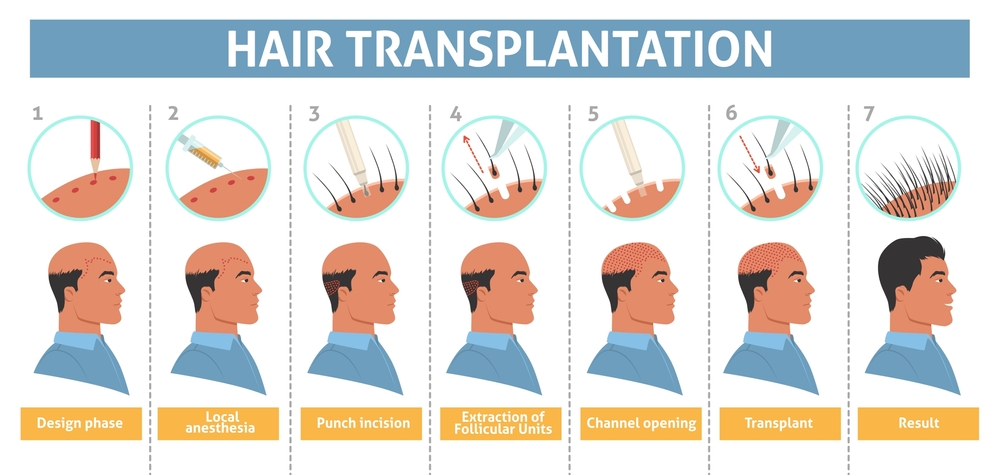
- The FUE hair transplant procedure in Turkey follows a clear medical process. It is usually completed in one day. Each step affects the final result, especially natural appearance and density.
- Scalp evaluation and graft planning: The process starts with a scalp check. The surgeon examines the donor area and estimates the number of grafts. This step defines what is possible based on available hair.
- Hairline design: The surgeon designs the hairline while the patient is awake. Shape and symmetry are adjusted before the hair transplant procedure begins.
- Local anesthesia: Local anesthesia is applied to the donor and recipient areas. The hair transplant operation is then performed without pain.
- Follicle extraction: The surgeon removes follicles one by one from the donor area using small tools. This step is part of the hair transplant procedure and protects the surrounding tissue.
- Graft storage: The extracted grafts are placed in a preservation solution to keep them viable.
- Recipient area preparation: Small channels are created in the thinning areas. These guide the placement, angle, and direction of the new hair.
- Graft implantation: Each graft is implanted one by one. The angle and direction are controlled to match natural hair growth.
Hair Loss Treatments
Get In Touch With Us
Call Us Anytime
+1 929 7101 505
+90 537 462 26 09
+90 537 462 26 09
Email Us
contact@carebridgeus.com
Book A Free Consultation
Request your free consultation with CareBridge US by filling out the form below. Our team will contact you to discuss your treatment goals and guide you through your medical journey in Turkey.
FUE Hair Transplant Recovery
Recovery follows a predictable biological cycle rather than a linear improvement.
In the first days, mild redness and small scabs appear in both donor and recipient areas. This phase is temporary and usually resolves within one to two weeks.
A shedding phase follows during the first month. Transplanted hairs fall out as follicles enter a resting phase. This is expected and does not indicate failure.
Growth begins gradually between month three and four. Initial hair is fine and irregular, with density increasing over time.
- Day 1 to 14: redness and scabs.
- Week 3 to 4: shedding phase.
- Month 3 to 4: early regrowth.
- Month 6: visible density improvement.
- Month 9 to 12: final result.
Final outcomes depend entirely on donor supply. Advanced hair loss patterns cannot reach full original density due to graft limitations.
Preparation for FUE Hair Transplant
Preparation directly influences graft survival and recovery quality. In the week before the procedure, smoking and alcohol are typically discontinued to support circulation. Any medication affecting blood flow is reviewed under medical supervision.
The scalp is cleansed the day before using specific antiseptic products. On the day of the procedure, no styling products are used, and clothing is selected to avoid contact with the scalp.
- Stop smoking and alcohol.
- Review medications with physician.
- Clean scalp before procedure.
- Avoid scalp contact with clothing.
Post-procedure positioning during sleep is also important, especially in the first nights when graft stability is most sensitive.
Risks and Limitations of FUE Hair Transplant
The FUE hair transplant is considered safe in controlled medical environments, but it is not without limitations.
Temporary effects may include swelling, discomfort, and shedding during early stages. These are part of the normal healing cycle.
More structural limitations define long-term results. The number of grafts is fixed, and hair loss may continue outside treated zones. Hair thickness and natural characteristics remain unchanged.
- Limited donor supply.
- Continued natural hair loss possible.
- Unchanged hair texture.
- Micro scarring in donor area.
Outcome quality depends more on planning than on technique. Overharvesting or poor design can negatively affect both appearance and donor reserves.
Before & After
Results
See how FUE hair transplant can help restore natural-looking density and improve hairline appearance through carefully planned treatment coordination. Each result depends on the patient’s hair loss level, donor area quality, graft planning, and individual healing process.


What does FUE mean?
How many grafts do I need?
Depends on your degree of hair loss, donor density, and goals. Typical sessions range from 1,500–4,000 grafts. Your surgeon designs a realistic plan based on available donor supply.
When will my transplanted hair grow?
Shedding of transplanted hairs occurs 2–4 weeks post-op (normal). New growth begins at 3–4 months. Significant density appears at 6–9 months. Full results at 12–18 months.
Is the result permanent?
Transplanted hair from the permanent donor zone is genetically resistant to balding and typically lasts a lifetime. However, native non-transplanted hair may continue thinning, potentially requiring future sessions or medical therapy.
What is shock loss?
Temporary shedding of native hairs near transplant sites due to surgical trauma. It regrows within 3–4 months in most cases. Minimizing trauma and proper post-op care reduce risk.
Get Your
Free Consultation
Speak With
A Medical
Consultant
Fill out the form and our team will contact you with personalized guidance and treatment information.
Copyright 2026 by Carebridge US. All rights reserved.
Copyright 2026 by Carebridge US. All rights reserved.