


Female pattern hair loss differs from male pattern diffuse thinning across the crown rather than receding hairline and bald crown. Surgical planning must preserve existing hair and address specific patterns.
Women’s Hair Transplant
in Turkey
Hair loss can gradually affect confidence, appearance, and self-image over time. Women’s hair transplant has become one of the most popular solutions for patients seeking natural-looking and long-lasting results with minimal visible scarring.
Turkey is recognized worldwide for advanced hair transplant procedures, experienced specialists, and modern medical facilities. CareBridge US helps international patients access trusted providers while guiding them through every step of the journey from consultation to recovery.
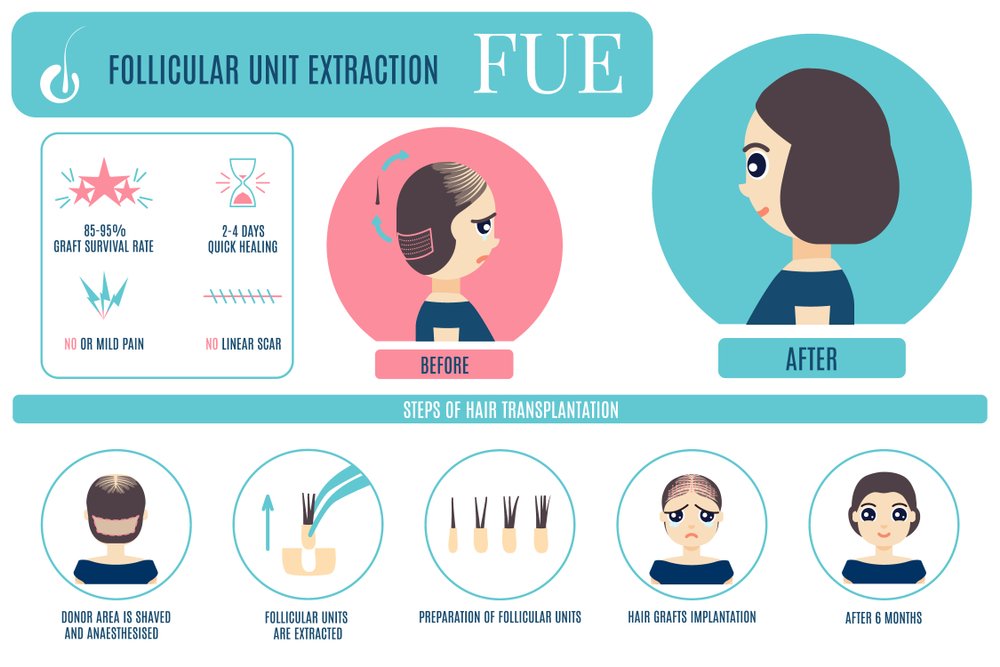
FUE (Follicular Unit Extraction) adapted for female patterns is commonly recommended for patients seeking wider coverage and natural-looking density. The procedure involves extracting individual hair follicles from donor areas and implanting them into regions affected by thinning or hair loss, with careful placement between existing strands to preserve natural density flow.
What is women’s hair transplant in Turkey
A women’s hair transplant in Turkey is based on follicular unit extraction, a technique where individual hair follicles are removed from the donor area and implanted into thinning regions of the scalp.
The condition most often treated is female pattern hair loss, where density decreases gradually across the top of the head without creating complete bald patches.
Doctors also evaluate other causes of localized or permanent thinning:
- Androgenetic alopecia leading to progressive crown and part line thinning
- Traction alopecia caused by tight hairstyles that damage follicles over time
- Hairline recession affecting frontal density
- Scarring alopecia or injury-related hair loss where follicles cannot regenerate
- Hormonal changes such as pregnancy, menopause, or thyroid imbalance
The donor area remains the biological limit of the procedure. If it lacks density, transplantation cannot compensate for it.
Who is a good candidate for women’s hair transplant in Turkey
Eligibility depends less on appearance and more on stability of hair loss.
The first requirement is a stable pattern over 12–24 months. Ongoing shedding changes results and makes planning unreliable.
The second is donor quality. The back and sides of the scalp must contain strong, uniform follicles that can be safely redistributed without creating visible thinning.
Medical teams also evaluate whether the loss is permanent. Conditions like androgenetic alopecia or traction alopecia are suitable. Temporary shedding conditions are not.
Scalp health is another factor. Active inflammation, infections, or autoimmune activity can affect graft survival and healing quality.
In suitable cases:
- hair loss has stabilized over time
- donor density is sufficient for redistribution
- scalp condition is healthy
- expectations match biological limits
- no active diffuse donor thinning is present
Women with rapidly progressing diffuse loss across both donor and recipient zones are usually not considered suitable candidates.
Women’s hair transplant process in Turkey
The women’s hair transplant process in Turkey is based on controlled follicular redistribution rather than rapid step execution. Each stage is planned around preserving existing hair and maintaining natural density flow.
Evaluation comes first. The donor area is analyzed under magnification, and the thinning pattern is mapped across the part line and crown. Female hairlines are not reconstructed aggressively; they are refined to maintain softness and natural density variation.
Local anesthesia is then applied to ensure both donor and recipient areas remain comfortable throughout the session.
Follicles are extracted individually using micro-punch tools, ensuring minimal disruption to surrounding tissue. Each graft is preserved in a specialized solution to maintain viability.
Attention then shifts to implantation. Tiny channels are created between existing hairs in thinning zones. This step is critical in female cases because existing strands must be preserved rather than replaced.
Implantation is performed graft by graft, following natural direction and angle to maintain uniform density without creating visible clustering.
In some cases, DHI (Direct Hair Implantation) is used, where grafts are implanted directly using a Choi pen without pre-made channels, allowing more precise placement in dense areas.
A full session typically lasts 6–8 hours depending on graft requirement, usually between 1,500 and 3,000 grafts for most female cases.
Hair Loss Treatments
Get In Touch With Us
Call Us Anytime
+1 929 7101 505
+90 537 462 26 09
+90 537 462 26 09
Email Us
contact@carebridgeus.com
Book A Free Consultation
Request your free consultation with CareBridge US by filling out the form below. Our team will contact you to discuss your treatment goals and guide you through your medical journey in Turkey.
Recovery after women’s hair transplant in Turkey
Recovery follows a predictable biological timeline rather than immediate visual change.
In the first week, mild redness and small scabs appear in treated areas. These are temporary and usually fade within 7–10 days.
During weeks 2 to 4, transplanted hairs shed. This phase is expected and reflects follicle transition into a resting stage beneath the skin.
New growth begins around month 3 to 4. Initial hairs are fine and soft, gradually becoming more visible over time.
By month 6, density improvements become noticeable in natural lighting conditions rather than controlled environments.
Final results typically develop between 12 and 18 months. In female cases, maturation can take slightly longer due to diffuse integration with existing hair.
The transplanted follicles remain permanent once fully stabilized and continue their natural growth cycle.
Risks and limitations
A woman’s hair transplant in Turkey is considered low-risk, but it operates within fixed biological constraints.
Temporary effects may include:
- mild swelling in the forehead area for a few days
- sensitivity or tightness of the scalp
- small scabs that resolve naturally
- temporary shedding of existing hair (shock loss)
- uneven early growth during the first months
These responses are part of normal healing and do not indicate failure.
Permanent limitations remain important:
Donor supply limits maximum density.
Ongoing hair loss may continue in untreated areas.
Hair thickness cannot be altered through transplantation.
Small white dot scarring remains in the donor zone.
Early uneven growth may appear before full maturation.
Female donor areas may also present lower density compared to male cases, which affects final coverage potential.
Reputable clinics communicate these limits clearly before any procedure begins.
How to prepare for women’s hair transplant in Turkey
Preparation focuses on stabilizing scalp conditions before the procedure.
Smoking and alcohol are typically stopped at least one week prior due to their impact on circulation.
Any medication affecting blood flow is reviewed medically before continuation.
On the day before, the scalp is washed thoroughly with provided antibacterial products, and no styling products are used afterward.
General preparation includes:
- avoiding alcohol and smoking before treatment
- reviewing medication with a physician
- maintaining a clean, product-free scalp
- wearing comfortable, non-overhead clothing
- following personalized clinic instructions
Medical evaluation for women’s hair transplant in Turkey
A medical evaluation determines whether transplantation is biologically appropriate.
Photographs of the part line, crown, and donor area are analyzed to assess density and pattern stability.
From this, a realistic graft range and expected coverage outcome are established.
If suitable, planning continues. If not, medical limitations are clearly explained along with non-surgical alternatives where applicable.
Before & After
Results
See how female hair restoration can help address thinning areas and restore natural-looking density through carefully planned treatment coordination. Each result depends on the patient’s hair loss pattern, donor area quality, graft distribution strategy, and individual healing process.
![CareBridge - Hair Transplant For Women - Before and after [04]](https://carebridgeus.com/wp-content/uploads/2026/05/CareBridge-Hair-Transplant-For-Women-Before-and-after-04.jpg "CareBridge - Hair Transplant For Women - Before and after [04]")
![CareBridge - Hair Transplant For Women - Before and after [03]](https://carebridgeus.com/wp-content/uploads/2026/05/CareBridge-Hair-Transplant-For-Women-Before-and-after-03.jpg "CareBridge - Hair Transplant For Women - Before and after [03]")
![CareBridge - Hair Transplant For Women - Before and after [02]](https://carebridgeus.com/wp-content/uploads/2026/05/CareBridge-Hair-Transplant-For-Women-Before-and-after-02.jpg "CareBridge - Hair Transplant For Women - Before and after [02]")
![CareBridge - Hair Transplant For Women - Before and after [01]](https://carebridgeus.com/wp-content/uploads/2026/05/CareBridge-Hair-Transplant-For-Women-Before-and-after-01.jpg "CareBridge - Hair Transplant For Women - Before and after [01]")
Is hair transplant different for women?
Can women undergo FUE without shaving their head?
Yes, many clinics offer “unshaven” or “long hair” FUE where only small donor zones are trimmed, allowing surrounding hair to conceal the area. This is more labor-intensive but preserves appearance during recovery.
What causes female hair loss?
Genetics, hormonal changes (pregnancy, menopause, PCOS), thyroid disorders, iron deficiency, autoimmune conditions, and certain medications. A thorough medical evaluation is essential before considering surgery.
Is hairline lowering possible for women?
Yes, surgical hairline advancement (forehead reduction) can lower a high hairline by 1–3 cm. This is often combined with hair transplantation for optimal density and natural transition.
Can women with diffuse thinning get transplants?
Only if sufficient stable donor hair exists. Women with widespread thinning may not be candidates because transplanted hair may be surrounded by continuing loss, creating patchy results. Medical therapy (minoxidil, finasteride, PRP) may be recommended first.
Get Your
Free Consultation
Speak With
A Medical
Consultant
Fill out the form and our team will contact you with personalized guidance and treatment information.
Copyright 2026 by Carebridge US. All rights reserved.
Copyright 2026 by Carebridge US. All rights reserved.