


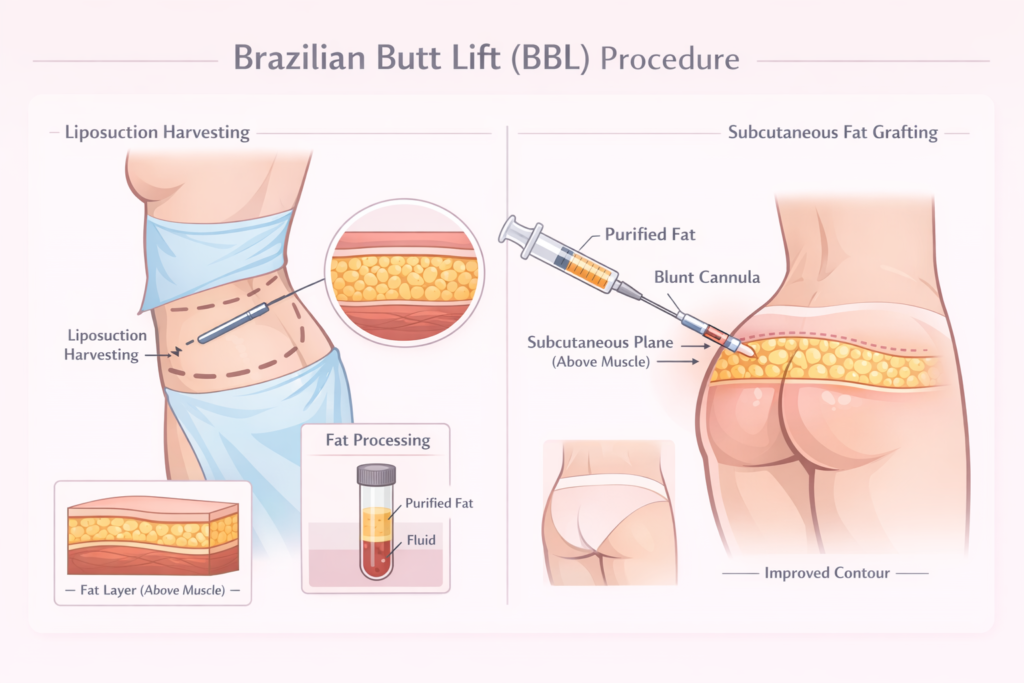
Fat is harvested via liposuction from donor areas (abdomen, flanks, thighs, back), purified, and strategically injected into the buttocks to enhance shape, projection, and proportion. No implants are used.
Brazilian Butt Lift (BBL)
in Turkey
Body proportion concerns can gradually affect confidence, appearance, and self-image over time. A Brazilian Butt Lift (BBL) has become one of the most popular solutions for patients seeking natural-looking and long-lasting results using their own tissue.
Turkey is recognized worldwide for advanced cosmetic procedures, experienced specialists, and modern medical facilities. CareBridge US helps international patients access trusted providers while guiding them through every step of the journey from consultation to recovery.
BBL is an autologous fat transfer procedure commonly recommended for patients seeking to enhance gluteal volume and projection. The procedure involves harvesting fat via liposuction from donor areas, purifying it, and reinjecting it into the buttocks in small, controlled layers to improve shape and proportion.
What is a Brazilian Butt Lift (BBL) in Turkey?
A BBL in Turkey is based on autologous fat transfer, meaning the fat used comes from the patient’s own body. It is not an implant-based procedure.
Fat is harvested from areas where it is stored in excess and then transferred into the gluteal region. This changes volume distribution rather than creating artificial shape.
The procedure is generally considered when:
- there is sufficient donor fat available
- gluteal projection is low relative to body frame
- body proportions are uneven after weight loss or pregnancy
It is important to understand that transferred fat does not fully survive. A portion is naturally reabsorbed by the body during healing, which affects final volume.
How Brazilian Butt Lift (BBL) works at tissue level
At tissue level, the procedure depends on fat cell survival and revascularisation. Once transferred, fat cells must establish a new blood supply to remain viable.
The process is not immediate. It occurs gradually over several weeks.
Main biological stages:
- liposuction harvesting of donor fat
- fat purification and filtration to remove non-viable material
- layered fat injection into gluteal tissue planes
- vascular integration phase during healing
Fat is placed in small deposits rather than a single mass. This increases surface contact with surrounding tissue, which improves survival probability.
Who is the best candidate for Brazilian Butt Lift (BBL) in Turkey?
Suitability is determined by anatomy, not aesthetic preference alone. The key factor is whether enough fat exists to allow safe transfer.
Candidates are typically evaluated on several physical and medical parameters:
- stable body weight over time
- sufficient donor fat in abdomen, flanks, or thighs
- acceptable skin elasticity
- absence of active infection or uncontrolled disease
- non-smoking status or cessation before procedure
Very low body fat levels reduce feasibility. In such cases, fat transfer may not provide predictable results.
Patients with unstable weight or metabolic conditions are also assessed more cautiously because fat survival is influenced by systemic healing capacity.
Brazilian Butt Lift (BBL) procedure in Turkey
The procedure is performed under general anesthesia in a hospital environment. It is not a short intervention and usually follows a structured sequence over several hours.
The clinical process includes:
- marking of donor and recipient zones
- fat extraction using liposuction techniques
- purification and separation of viable fat cells
- controlled fat injection into gluteal tissue
- application of compression garments
Fat is injected in small volumes across multiple tissue layers. This reduces local pressure and supports gradual blood vessel formation around the transferred cells.
Patients are monitored after the procedure before discharge, usually within one to two days depending on clinical response.
Plastic Surgery Treatments
Get In Touch With Us
Call Us Anytime
+1 929 7101 505
+90 537 462 26 09
+90 537 462 26 09
Email Us
contact@carebridgeus.com
Book A Free Consultation
Request your free consultation with CareBridge US by filling out the form below. Our team will contact you to discuss your treatment goals and guide you through your medical journey in Turkey.
Recovery from Brazilian Butt Lift (BBL)
Recovery is defined by tissue adaptation rather than immediate visual change. Early healing focuses on protecting transferred fat cells from pressure and trauma.
The first phase is mechanically restrictive. Sitting directly on the buttocks is avoided because it reduces blood flow to the newly transferred fat.
Typical progression:
- week 1: limited mobility, positioning restrictions, swelling present
- weeks 2–3: partial reduction in swelling, early fat absorption phase
- weeks 4–6: gradual return to light daily activity
- months 3–6: contour becomes more stable
- up to 12 months: final tissue settling
Swelling and asymmetry are expected during early healing and do not reflect final outcome.
Compression garments are used primarily on donor areas to support tissue contraction and fluid control.
Risks and limitations of Brazilian Butt Lift (BBL)
The procedure has known medical risks associated with both liposuction and fat transfer. Most are manageable, but require clinical awareness.
Temporary and expected effects include:
- swelling in donor and recipient regions
- bruising in areas treated with liposuction
- temporary firmness or uneven texture
- early asymmetry during healing
Clinically relevant complications may include:
- seroma (fluid accumulation)
- fat necrosis (localized fat cell death)
- infection at donor or recipient sites
- contour irregularities
- hematoma formation
A specific risk associated with fat transfer is fat embolism, which is linked to incorrect injection depth. Modern protocols avoid deep muscular injection and limit placement to subcutaneous layers.
Risk levels increase in smokers, patients with high BMI, or those with impaired healing capacity.
Limitations of Brazilian Butt Lift (BBL)
The outcome is biologically constrained and cannot be fully controlled.
Key limitations:
- partial fat absorption after procedure
- dependence on long-term weight stability
- no exact control over final volume
- changes with weight gain or loss
- small permanent liposuction entry scars
Weight variation affects both donor and recipient fat cells. As a result, long-term stability depends on maintaining consistent body weight.
Why BBL is performed in Turkey
BBL procedures in Turkey follow internationally recognized medical protocols. Fat extraction and transfer techniques are consistent with those used in Europe and other regions.
Differences are mainly organizational rather than technical. Hospitals operate with structured clinical systems, defined safety workflows, and coordinated post-procedure monitoring pathways.
Medical evaluation before Brazilian Butt Lift (BBL)
Medical evaluation is based on whether fat transfer can be performed safely from an anatomical and metabolic perspective. The focus is not aesthetic preference but structural feasibility and expected tissue behaviour after transfer.
The assessment is not identical for every patient and is adjusted according to body composition and health profile.
In clinical practice, evaluation may include:
- measurement of donor fat distribution in abdomen, flanks, and posterior trunk
- assessment of skin quality and elasticity in both donor and gluteal regions
- review of gluteal tissue capacity to determine safe volume accommodation
- evaluation of body mass index (BMI) in relation to procedural risk
- review of medical history, particularly conditions affecting healing or circulation
From these findings, a realistic estimate is made regarding possible fat transfer volume and the degree of contour change that can be achieved. This estimate remains conservative because fat survival varies after transfer.
When donor fat is insufficient or when risk factors are identified, the procedure may be postponed or alternative approaches may be discussed.
Before & After
Results
See how BBL can help enhance lower body proportions and create a more sculpted silhouette through carefully planned fat transfer coordination. Each result depends on the patient’s donor fat availability, body proportions, graft survival rate, and individual healing process.
![CareBridge - BBL - Before and after [03]](https://carebridgeus.com/wp-content/uploads/2026/05/CareBridge-BBL-Before-and-after-03.jpg "CareBridge - BBL - Before and after [03]")
![CareBridge - BBL - Before and after [02]](https://carebridgeus.com/wp-content/uploads/2026/05/CareBridge-BBL-Before-and-after-02.jpg "CareBridge - BBL - Before and after [02]")
![CareBridge - BBL - Before and after [01]](https://carebridgeus.com/wp-content/uploads/2026/05/CareBridge-BBL-Before-and-after-01.jpg "CareBridge - BBL - Before and after [01]")
![CareBridge - BBL - Before and after [04]](https://carebridgeus.com/wp-content/uploads/2026/05/CareBridge-BBL-Before-and-after-04.jpg "CareBridge - BBL - Before and after [04]")
How does BBL work?
How much fat survives after transfer?
Typically 60–80% of transferred fat establishes permanent blood supply. The remaining 20–40% is naturally absorbed by the body within the first 3–6 months. Surgeons initially overfill slightly to compensate.
Why can't I sit directly after BBL?
Pressure on the buttocks during the first 2–3 weeks can compromise blood flow to newly transferred fat cells, causing them to die. You must use a BBL pillow, sit on your thighs, or lie on your stomach.
How long before I see final results?
Initial shape is visible immediately but swollen. Final results emerge at 3–6 months after swelling resolves and fat survival stabilizes.
Can I get BBL if I don't have much body fat?
Very lean patients may lack sufficient donor fat. Alternatives include gaining weight pre-operatively, multiple small-volume sessions, or buttock implants (though implants carry higher complication rates).
What happens if I lose weight after BBL?
Transferred fat behaves like fat anywhere on your body it shrinks with weight loss and expands with weight gain. Significant weight loss can reduce buttock volume.
Is BBL safe?
BBL has higher mortality risk than most cosmetic procedures due to fat embolism if fat is injected into gluteal veins. Choosing a surgeon who uses ultrasound guidance and injects only into the subcutaneous plane (not muscle) is critical. Accredited Turkish clinics follow these safety protocols.
Get Your
Free Consultation
Speak With
A Medical
Consultant
Fill out the form and our team will contact you with personalized guidance and treatment information.
Copyright 2026 by Carebridge US. All rights reserved.
Copyright 2026 by Carebridge US. All rights reserved.