


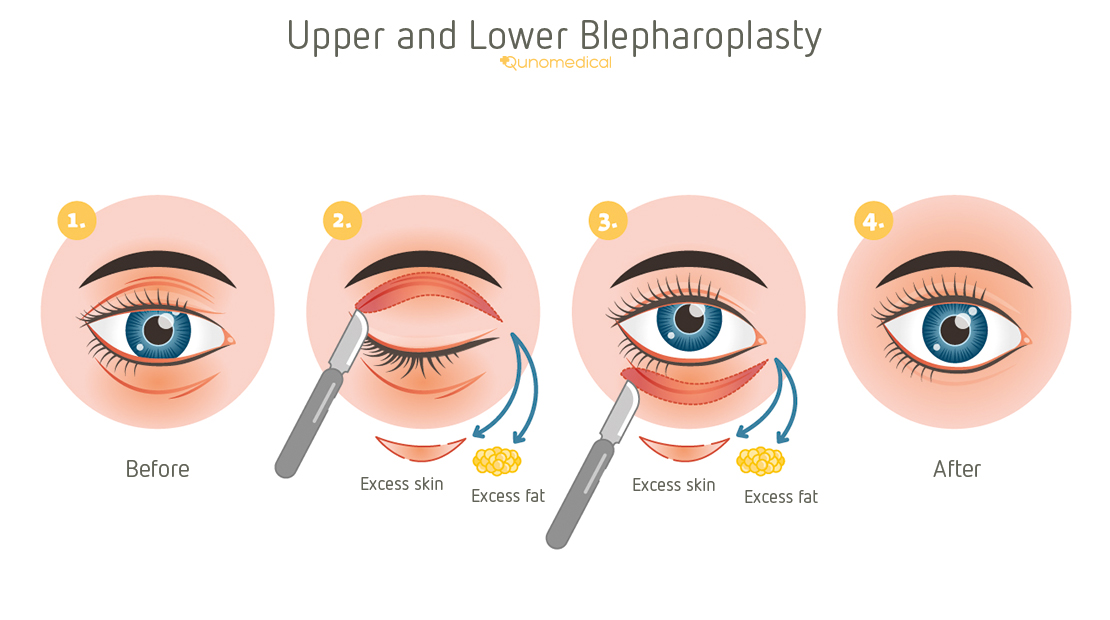
Upper eyelid surgery removes excess skin that hoods the eye. Lower eyelid surgery addresses bags, puffiness, and wrinkles. Many patients benefit from both. Your surgeon assesses which areas will achieve your goals.
Eyelid procedure (Blepharoplasty)
in Turkey
Eyelid aging and puffiness can gradually affect confidence, appearance, and self-image over time. Eyelid procedure has become one of the most popular solutions for patients seeking natural-looking and long-lasting results with a more alert, refreshed appearance.
Turkey is recognized worldwide for advanced cosmetic procedures, experienced specialists, and modern medical facilities. CareBridge US helps international patients access trusted providers while guiding them through every step of the journey from consultation to recovery.
Eyelid procedure (blepharoplasty) is commonly recommended for patients seeking to correct drooping upper eyelids, under-eye bags, or excess skin that creates a tired appearance. The procedure involves removing or repositioning excess skin, muscle, and fat from the upper and/or lower eyelids to restore a smoother, more open eye contour.
What is blepharoplasty?
Two common conditions indicate the need for blepharoplasty.
Dermatochalasis refers to laxity or redundancy of eyelid skin and muscle, caused by loss of elastic tissue, thinning of the epidermis, weakening of connective tissue, mechanical forces (rubbing), and aging. Genetic influences are also strong.
Steatoblepharon (from the Greek steatos meaning “relating to fat”) is the prominence of eyelid fat pads, applying to both upper and lower eyelids. It may be associated with weakening of the orbital septum and overlying orbicularis muscle and skin. Both conditions are usually noticed in the fourth decade but sometimes earlier.
Upper blepharoplasty focuses primarily on removal of excess skin and aesthetic placement of the supratarsal crease, along with filling and contouring of a deep upper orbital sulcus when necessary. The upper lid should be approached transcutaneously, whereas lower blepharoplasty can be safely performed through a transconjunctival or transcutaneous incision.
What are the different blepharoplasty techniques?
Upper eyelid blepharoplasty. The incision is made along the natural eyelid crease, usually with a scalpel or needle to minimize scarring and bleeding. Excess skin and fat are removed. The goal is to restore the visible tarsal platform while maintaining a natural upper lid fold. Excessive removal of fat or skin can efface this fold, giving an unnatural appearance.
Lower eyelid blepharoplasty. Two main approaches exist.
- Transconjunctival blepharoplasty. The incision is made on the inside of the lower eyelid (the conjunctiva), leaving no external scar. This technique provides excellent access to the inferior fatty chambers and has a lower complication rate than the transcutaneous approach. It is ideal for patients with pseudoherniated orbital fat and good skin elasticity but no significant excess skin.
- Transcutaneous blepharoplasty (subciliary). The incision is made externally just below the lower eyelash line. This approach allows simultaneous removal of both fat and excess skin, making it suitable for patients with significant skin redundancy.
If there is significant laxity of the lower eyelid, a canthopexy or canthoplasty (tightening procedure) may be performed at the same time.
Who is the best candidate for eyelid procedure?
Candidates have documented signs of periocular aging or functional impairment.
- Excessive, sagging, or wrinkled upper or lower eyelid skin. Puffy pouches of fat in the upper or lower eyelids creating a tired or aged appearance.
- Excess upper eyelid skin that interferes with vision. Dermatochalasis severe enough to block the superior visual field qualifies as functional blepharoplasty, sometimes covered by insurance.
- Loss of natural upper eyelid crease. Some patients have no defined crease, particularly certain ethnic groups.
- Good general health. No uncontrolled hypertension, diabetes, or bleeding disorders. Eye disease must be excluded before procedure.
- Non-smoker or willing to quit for at least four weeks preoperatively. Nicotine impairs wound healing and increases complication rates.
- Realistic expectations. The procedure improves periorbital appearance and may widen visual fields but does not eliminate all wrinkles or stop the aging process. Scars are permanent but well hidden in natural creases or inside the eyelid.
Contraindications. Untreated dry eye syndrome, active ocular infection (conjunctivitis, blepharitis), thyroid eye disease without stable ophthalmology clearance, severe hypertension or diabetes, unrealistic expectations.
Blepharoplasty process in Turkey
The operation is usually performed on an outpatient basis under local anesthesia with sedation or general anesthesia. Blepharoplasty may be carried out alone or in conjunction with other facial procedures such as a facelift or brow lift.
Consultation. The surgeon reviews medical history and performs a comprehensive ophthalmic examination to exclude any eye disease or dry eye syndrome. Visual field testing may be performed for functional cases. Skin quality, degree of dermatochalasis, fat herniation, and eyelid laxity are assessed. Preoperative photographs are obtained for medical records.
- Anesthesia: Local anesthesia with conscious sedation or general anesthesia, administered by a specialist anesthesiologist. Operating time ranges from 1 to 3 hours.
- Upper eyelid incision and tissue resection: The surgeon marks the natural upper lid crease with the patient in an upright position. An incision is made along the marked line. Excess skin, orbicularis muscle, and herniated fat are excised. The preaponeurotic fat pads are accessed via incision of the orbital septum. Conservative resection of fat is essential to avoid an empty, hollowed appearance and preserve a natural 3-dimensional contour. Hemostasis is achieved with electrocautery.
- Lower eyelid incision and tissue resection: For transconjunctival approach, the lower lid is retracted and the incision is made through the conjunctiva and lower eyelid retractors, approximately 4-5mm below the tarsal border. The orbital septum is opened, and herniated fat pads (medial, central, and lateral compartments) are identified. The inferior oblique muscle separates the medial and central fat pads and must be preserved. Fat is
- excised conservatively or repositioned to fill the tear trough deformity: The conjunctiva is closed with absorbable suture or left to heal by secondary intention.
- For transcutaneous (subciliary) approach, the incision extends from just below the punctum medially to the lateral canthus, following the lash line. A skin-muscle flap is elevated, the orbital septum is opened, and fat is excised or repositioned. If excess skin remains, a skin strip is excised. In older patients with significant skin redundancy, a pinch excision technique removes skin without muscle to preserve orbicularis tone.
- Closure: Upper eyelid incisions are closed with running or interrupted non-absorbable sutures, usually removed at 5-7 days. Transconjunctival incisions may be closed with absorbable suture or left open. A lubricating ointment is applied.
Plastic Surgery Treatments
Get In Touch With Us
Call Us Anytime
+1 929 7101 505
+90 537 462 26 09
+90 537 462 26 09
Email Us
contact@carebridgeus.com
Book A Free Consultation
Request your free consultation with CareBridge US by filling out the form below. Our team will contact you to discuss your treatment goals and guide you through your medical journey in Turkey.
Recovery after blepharoplasty
Healing follows a predictable sequence.
First 24-72 hours. Swelling and bruising peak during this period. Cold compresses are applied for 10-15 minutes every hour for the first 48-72 hours. Keep head elevated even when sleeping. Suture lines are kept clean and dry. Blurred vision from ointment is common. Artificial tears are used frequently.
Day 5-7. Sutures are usually removed. Bruising and most swelling have subsided. Most patients return to work at this point, though residual swelling may still be noticeable.
Week 2. Swelling usually disappears. Sensitivity to light subsides. Bruising resolves. Makeup may be used following suture removal and healing of incisions. Contact lenses can be worn when comfortable, typically at 7-10 days.
Month 1-3. Eyelids continue to settle. Residual edema and temporary numbness resolve. Incisional scars begin fading from red to pink. Incisions are sensitive to ultraviolet radiation; consistent sunscreen use (SPF 30+) is required for at least 6 months to prevent hyperpigmentation. Avoid rubbing eyes or applying excessive creams.
Month 6-12. Scars mature, becoming thin and pale. Final results are visible. Some patients may still experience mild residual asymmetry, but most report significant improvement in periorbital appearance and peripheral vision.
Risks and limitations
Eyelid procedure has a low overall complication profile. The majority of functional and aesthetic concerns can be resolved with conservative management or revisionary procedure.
Common temporary effects. Swelling, bruising, temporary dry or irritated eyes, mild discomfort controlled with oral medication, transient blurred vision, sensitivity to light, temporary numbness of the eyelid skin. Bruising usually resolves within 2 weeks.
Complications requiring intervention. Infection (rare, treated with antibiotics). Bleeding (rare). Dry eyes requiring ongoing lubricant therapy. Asymmetry. Scarring visible outside natural creases. Difficulty closing eyes or other eyelid problems; this is a specific risk of lower blepharoplasty if too much skin is removed (ectropion).
Serious rare complications. Injury to eye muscles causing double vision. Retrobulbar hematoma (blood behind the eye); an emergency requiring immediate decompression to prevent vision loss. Blindness is extremely rare. Anesthesia complications. Major complications resulting in ocular and visual disturbances such as blindness or diplopia are not reported in large systematic reviews.
Permanent limitations. Scars are permanent but fade significantly over time. Some patients experience permanent dry eye requiring ongoing lubricant use. Eyelid asymmetry may persist despite surgical revision. The procedure cannot stop the aging process; gradual descent and skin relaxation will continue over subsequent decades.
How to prepare for blepharoplasty in Turkey
Preoperative medical preparation.
- Discontinue smoking at least four weeks before procedure. Nicotine delays healing and increases complication rates.
- Stop blood-thinning medications (aspirin, ibuprofen, warfarin, clopidogrel, fish oil, vitamin E) as directed by your surgeon.
- Complete preoperative laboratory tests (complete blood count, coagulation profile, chemistry panel).
- Obtain optometrist or ophthalmologist clearance to exclude dry eye syndrome, glaucoma, or other ocular pathology. Eye disease must be excluded before procedure.
- Achieve stable blood pressure and blood glucose if diabetic.
- Have a dental check-up to rule out any active infection.
Logistical preparation. Plan to stay in Turkey for 8-10 days. Early suture removal at 5-7 days is standard. Do not travel alone for the first 48 hours; you will need assistance. Pack front-fastening, loose-fitting tops; garments that pull over the head are not suitable for the first week. Purchase lubricating preservative-free artificial tears, cold gel compresses, and wrap-around sunglasses.
Before & After
Results
See how blepharoplasty can help refresh the eye area and reduce signs of aging or fatigue through carefully planned treatment coordination. Each result depends on the patient’s eyelid anatomy, skin excess, fat distribution, and individual healing process.
![CareBridge - Eyelid Lift - Before and after [02]](https://carebridgeus.com/wp-content/uploads/2026/05/CareBridge-Eyelid-Lift-Before-and-after-02.png "CareBridge - Eyelid Lift - Before and after [02]")
![CareBridge - Eyelid Lift - Before and after [04]](https://carebridgeus.com/wp-content/uploads/2026/05/CareBridge-Eyelid-Lift-Before-and-after-04.png "CareBridge - Eyelid Lift - Before and after [04]")
![CareBridge - Eyelid Lift - Before and after [03]](https://carebridgeus.com/wp-content/uploads/2026/05/CareBridge-Eyelid-Lift-Before-and-after-03.png "CareBridge - Eyelid Lift - Before and after [03]")
![CareBridge - Eyelid Lift - Before and after [01]](https://carebridgeus.com/wp-content/uploads/2026/05/CareBridge-Eyelid-Lift-Before-and-after-01.png "CareBridge - Eyelid Lift - Before and after [01]")
Upper, lower, or both eyelids?
Will eyelid surgery remove my crow's feet?
No. Eyelid surgery addresses the eyelids themselves, not lateral wrinkles. Crow’s feet are treated with Botox, laser resurfacing, or other modalities.
Where are the incisions?
Upper eyelid: hidden in the natural crease. Lower eyelid: just below the lash line (transcutaneous) or inside the eyelid (transconjunctival, no visible scar). Your anatomy determines approach.
Will I look "different" or just less tired?
Well-performed blepharoplasty refreshes your appearance without changing your fundamental look. You should look like a rested version of yourself, not someone else.
When can I wear makeup and contacts?
Makeup: 1–2 weeks. Contact lenses: typically 2 weeks until swelling subsides enough for comfortable insertion and removal.
Get Your
Free Consultation
Speak With
A Medical
Consultant
Fill out the form and our team will contact you with personalized guidance and treatment information.
Copyright 2026 by Carebridge US. All rights reserved.
Copyright 2026 by Carebridge US. All rights reserved.