

Medial (inner) thigh lift with incisions in the groin crease or extending down the inner thigh. Spiral thigh lift addresses inner and outer thighs. Mini thigh lift uses smaller incisions for mild laxity.
Thigh Lift
in Turkey
Loose inner thigh skin can gradually affect confidence, appearance, and self-image over time. A thigh lift has become one of the most popular solutions for patients seeking natural-looking and long-lasting results with smoother leg contours.
Turkey is recognized worldwide for advanced cosmetic procedures, experienced specialists, and modern medical facilities. CareBridge US helps international patients access trusted providers while guiding them through every step of the journey from consultation to recovery.
Thigh lift (thighplasty) is commonly recommended for patients seeking to remove excess skin and fat from the upper inner thighs. The procedure involves making incisions in the groin crease or along the inner thigh, removing excess tissue, tightening remaining structures, and lifting the area to reduce chafing and improve definition.
What is a thigh lift?
Thighplasty targets sagging skin that does not respond to diet or exercise. The problem usually appears after massive weight loss, with aging, or sometimes just due to genetics. The extra skin is not just a cosmetic issue. It causes chafing, rashes, and hygiene problems.
Several techniques exist. A medial thigh lift addresses the inner thigh with incisions hidden in the groin crease. A spiral thigh lift treats both inner and outer thighs with longer incisions. A mini thigh lift uses smaller cuts for mild laxity. Your surgeon chooses based on how much skin needs removal.
Who is the best candidate for a thigh lift in Turkey?
Good candidates have reached a stable weight and have realistic expectations about scars.
- Stable weight for 12 months. Future weight changes will stretch your skin again. That ruins the result. Surgeons want you at your goal weight before procedure.
- BMI under 30. Higher BMI increases complications like poor wound healing and infection. Some surgeons accept up to 32, but ideal is below 30.
- Healthy non-smoker. Smoking is a major risk. Nicotine severely impairs healing and increases the chance of wound breakdown. You must quit for at least four weeks before procedure.
- Good general health. No uncontrolled diabetes, heart problems, or bleeding disorders. Your body needs to heal predictably.
- Realistic expectations. The scar is permanent. It runs along your inner thigh or groin. You accept that trade-off in exchange for smoother legs.
Who is not a good candidate? People still losing weight. Smokers who cannot quit. Anyone with a BMI over 35. Patients expecting perfect skin with no visible scars.
Thigh lift process in Turkey
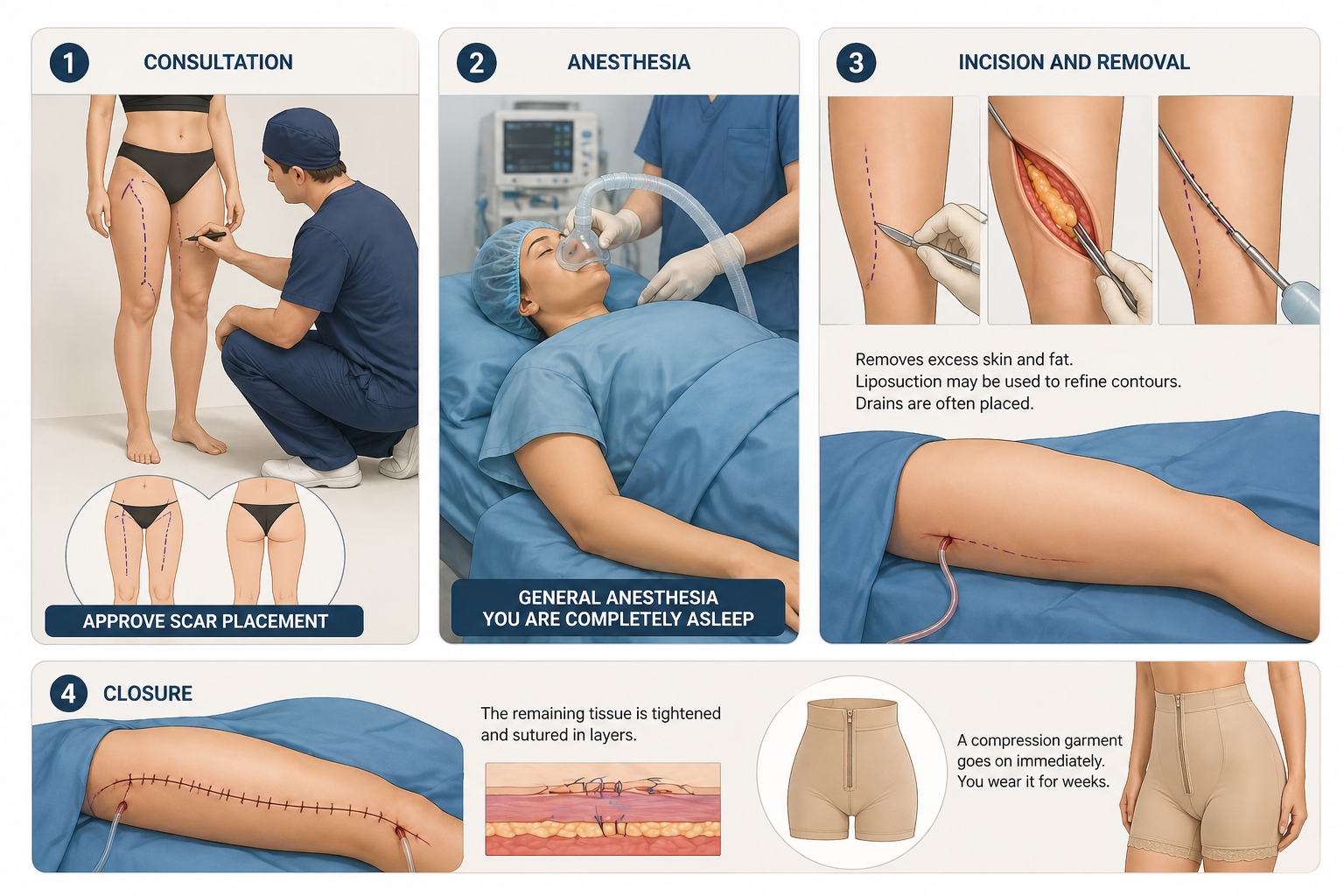
The procedure takes place in a hospital under general anesthesia. You stay overnight.
Consultation. The surgeon marks incision lines while you stand. They discuss which technique fits your anatomy. You approve the scar placement before anything happens.
Anesthesia. General. You are completely asleep.
Incision and removal. The surgeon cuts along the marked lines, removes excess skin and fat, and may use liposuction to refine contours. Drains are often placed to prevent fluid buildup.
Closure. The remaining tissue is tightened and sutured in layers. A compression garment goes on immediately. You wear it for weeks.
Recovery after a thigh lift
Recovery from thigh lift is substantial. The incision site is under constant tension from walking and sitting.
Hospital stay (1 night). You wake up with drains, compression garment, and pain medication. You walk within 24 hours to prevent blood clots. Legs are elevated to reduce swelling.
Week 1 to 2. Drains removed around day 2-5. Swelling and bruising peak. You cannot stand for long periods. Walking is limited. You need help with daily tasks. Most patients take 2 weeks off work.
Weeks 3 to 4. Swelling goes down. You may return to desk work if your job does not require standing. Compression garment worn most of the day. Still no exercise.
Weeks 6 to 8. Cleared for light exercise like walking. No heavy lifting, running, or squatting. The deep internal sutures need time to heal fully.
Month 3 to 6. Most swelling resolves. Results become visible. Scars start fading from red to pink.
Month 6 to 12. Final shape. Scars continue to mature. Full recovery can take up to a year.
Plastic Surgery Treatments
Get In Touch With Us
Call Us Anytime
+1 929 7101 505
+90 537 462 26 09
+90 537 462 26 09
Email Us
contact@carebridgeus.com
Book A Free Consultation
Request your free consultation with CareBridge US by filling out the form below. Our team will contact you to discuss your treatment goals and guide you through your medical journey in Turkey.
Risks and limitations
Thigh lift has higher complication rates than many other body contouring procedures. Most problems are minor but common.
Most common complications. Wound dehiscence (wound separation) affects 18-24% of patients. This is the most frequent issue. Seroma (fluid buildup) occurs in 8-18% of cases. Infection is less common.
Other possible complications. Swelling, bruising, numbness along incision lines. Pain that lasts weeks. Unsightly scarring. Asymmetry. Blood clots (rare).
Permanent limitations you must accept. The scar is permanent and visible when you wear shorts or a swimsuit. Some numbness may never fully return. Future weight gain will stretch the skin again and may cause sagging to recur.
How to prepare for a thigh lift in Turkey
Medical preparation. Stop smoking four weeks before procedure. Stop blood thinners as directed. Maintain stable weight. Get medical clearance.
Logistical preparation. Stay in Turkey 10 to 14 days. Do not travel alone – you will need help for the first week. Pack loose, front-fastening clothes. Nothing that pulls over your head.
Before & After
Results
See how thigh lift can help reshape the inner thighs and reduce skin friction through carefully planned treatment coordination. Each result depends on the patient’s degree of skin laxity, fat distribution, surgical technique, and individual healing process.
![CareBridge - Tight Lift - Before and after [04]](https://carebridgeus.com/wp-content/uploads/2026/05/CareBridge-Tight-Lift-Before-and-after-04.jpg "CareBridge - Tight Lift - Before and after [04]")
![CareBridge - Tight Lift - Before and after [03]](https://carebridgeus.com/wp-content/uploads/2026/05/CareBridge-Tight-Lift-Before-and-after-03.jpg "CareBridge - Tight Lift - Before and after [03]")
![CareBridge - Tight Lift - Before and after [02]](https://carebridgeus.com/wp-content/uploads/2026/05/CareBridge-Tight-Lift-Before-and-after-02.jpg "CareBridge - Tight Lift - Before and after [02]")
![CareBridge - Tight Lift - Before and after [01]](https://carebridgeus.com/wp-content/uploads/2026/05/CareBridge-Tight-Lift-Before-and-after-01.jpg "CareBridge - Tight Lift - Before and after [01]")
What types of thigh lifts exist?
Why is thigh lift recovery more difficult than other procedures?
The incision is under constant tension from walking, sitting, and leg movement. This makes wound healing more challenging and increases dehiscence (wound separation) risk to 18–24%.
How long before I can walk normally?
Short walks begin within 24 hours to prevent blood clots. Normal gait returns gradually over 2–3 weeks. Prolonged standing or walking is limited for 4–6 weeks.
Will the scar be visible in shorts or swimwear?
Medial thigh lift scars along the inner thigh may be visible in very short garments. Groin-crease incisions are better hidden. Your surgeon discusses scar placement during consultation.
Can I exercise after thigh lift?
Walking is encouraged immediately. Light exercise resumes at 4–6 weeks. Running, squats, and leg presses are restricted for 8–12 weeks until deep tissues fully heal.
Get Your
Free Consultation
Speak With
A Medical
Consultant
Fill out the form and our team will contact you with personalized guidance and treatment information.
Copyright 2026 by Carebridge US. All rights reserved.
Copyright 2026 by Carebridge US. All rights reserved.