

Closed rhinoplasty incisions are hidden inside the nostrils—no visible scar, limited access. Open rhinoplasty adds a small incision across the columella (skin between nostrils), allowing full structural visualization. Complex revisions and tip work typically require open approach.
Rhinoplasty (Nose Job)
in Turkey
Nasal shape or proportion concerns can gradually affect confidence, appearance, and self-image over time. Rhinoplasty has become one of the most popular solutions for patients seeking natural-looking and long-lasting results with improved facial harmony.
Turkey is recognized worldwide for advanced cosmetic procedures, experienced specialists, and modern medical facilities. CareBridge US helps international patients access trusted providers while guiding them through every step of the journey from consultation to recovery.
Rhinoplasty (commonly called a nose job) is commonly recommended for patients seeking to refine nasal appearance or improve breathing function. The procedure involves reshaping the bone and cartilage of the nose to address concerns such as a dorsal hump, wide bridge, bulbous tip, or deviated septum.
What is a rhinoplasty?
Patients seek rhinoplasty for two main categories of problems.
Aesthetic concerns. The hump on the bridge that has bothered you since adolescence. A bulbous or drooping tip that makes your nose look wider than it is. A nose that seems out of proportion with your other facial features. Asymmetry from birth or trauma. Nostrils that flare too much or appear too prominent.
Functional concerns. A deviated septum that makes one nasal passage narrower than the other. Nasal valve collapse that restricts airflow when you inhale. Breathing difficulties that affect sleep, exercise, or daily comfort. Rhinoplasty can be performed at the same time as deviated septum repair (septoplasty) to improve both form and function.
The surgical approaches fall into two categories. Closed rhinoplasty uses incisions hidden entirely inside the nostrils. There is no external scar. This works well for minor to moderate adjustments. Open rhinoplasty involves a small incision across the columella (the strip of tissue between your nostrils). This lifts the skin up and gives the surgeon direct vision of the underlying structures. It is preferred for complex reshaping and tip refinement. The external scar is tiny and usually fades to near invisibility.
Modern techniques have advanced significantly. Piezo rhinoplasty uses ultrasonic vibrations to cut bone instead of traditional chisels or rasps. Studies show it enables osteotomies with millimetre precision and minimal trauma to surrounding soft tissue. Patients typically experience less bruising, less swelling, and a more comfortable recovery. The technology is particularly useful for hump reduction and lateral osteotomies.
Who is the best candidate for rhinoplasty in Turkey?
Good candidates meet specific conditions that reduce complication risks and predictably good outcomes.
Physically mature. Surgeons prefer patients whose nasal growth is complete. For girls, this is around age 15-16. For boys, age 16-18. The nose stops growing at different times for different people, but these are general guidelines.
Good general health. No uncontrolled bleeding disorders, active infections, or chronic conditions that impair healing. You must be healthy enough for general anesthesia.
Non-smoker willing to quit. Smoking severely impairs blood flow to healing tissues. Most surgeons require you to stop for at least four weeks before procedure and remain smoke-free during recovery. Nicotine significantly increases the risk of skin necrosis and poor wound healing.
Stable weight. Large weight fluctuations can alter your facial proportions and affect the nasal appearance. You should be at or near your ideal weight.
Realistic expectations. Rhinoplasty refines the nose. It cannot create perfection or copy a celebrity’s nose onto your face. Your facial anatomy sets the limits. The goal is harmony, not perfection.
Rhinoplasty process in Turkey
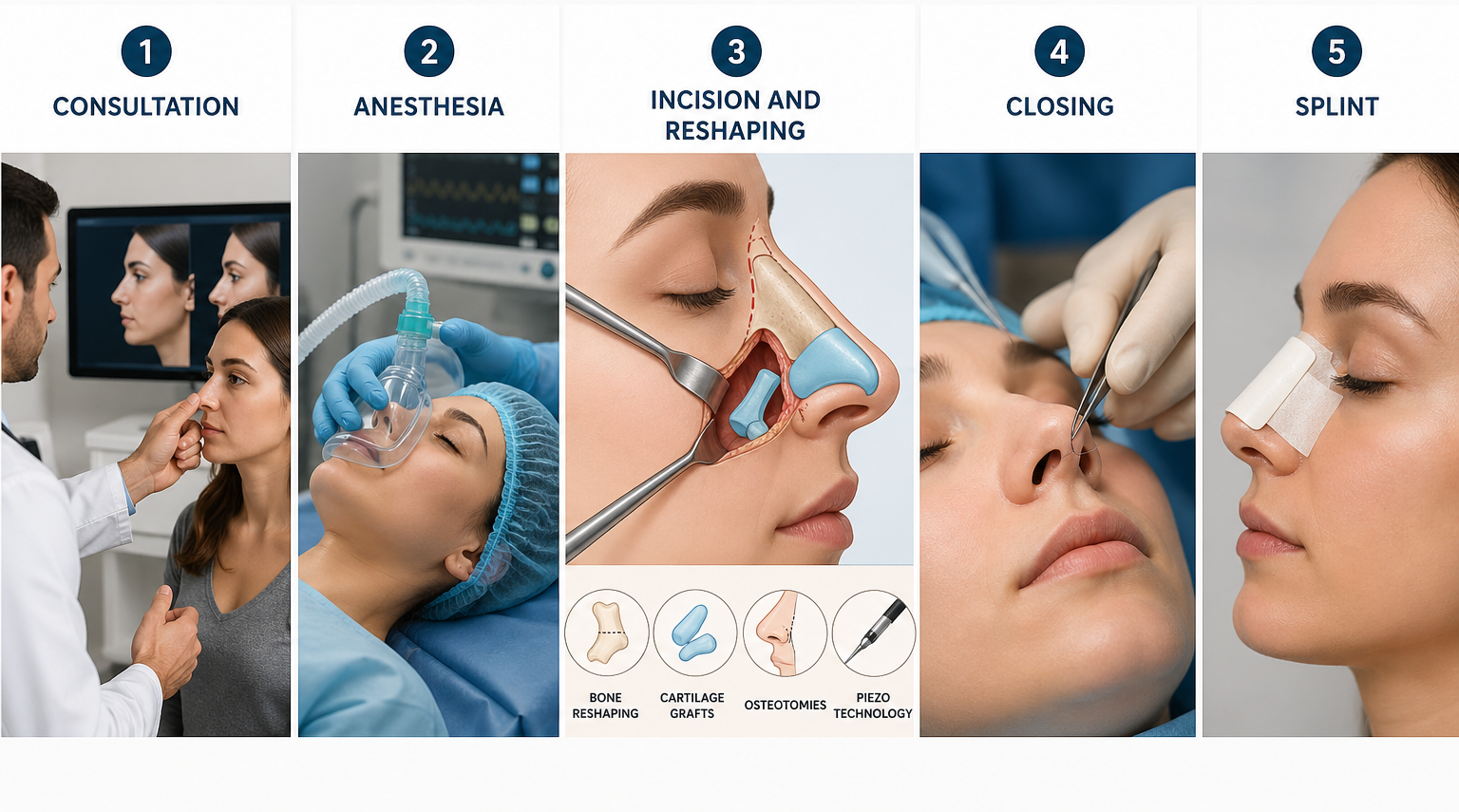
The procedure is performed under general anesthesia in a hospital setting. Most patients go home the same day.
Consultation. The surgeon examines your nasal anatomy internally and externally. They assess skin thickness, septum, airway, and breathing. They discuss your goals and show digital imaging of what is achievable. You approve the surgical plan before anything happens.
Anesthesia. General. You are completely asleep. The procedure typically takes 1.5 to 3 hours, depending on complexity.
Incision and reshaping. Bone and cartilage are reshaped. Grafts may be used. Osteotomies may narrow nasal bones. Piezo technology may be used.
Closing. Sutures are placed. A splint is applied.
Plastic Surgery Treatments
Get In Touch With Us
Call Us Anytime
+1 929 7101 505
+90 537 462 26 09
+90 537 462 26 09
Email Us
contact@carebridgeus.com
Book A Free Consultation
Request your free consultation with CareBridge US by filling out the form below. Our team will contact you to discuss your treatment goals and guide you through your medical journey in Turkey.
Recovery after a rhinoplasty
Patience is the most important factor. The nose heals slowly. Final results take a full year. Here is the timeline.
Days 1 to 3 after procedure. Swelling and bruising peak during this period. Puffiness spreads to the cheeks and around the eyes. Nasal congestion is significant. You breathe through your mouth. Pain is usually mild to moderate, well-managed with medication. The external splint is in place. You keep your head elevated at all times, even when sleeping.
Days 4 to 7. Bruising begins to fade. Swelling starts to decrease. Congestion slowly improves as internal swelling reduces. Many patients feel well enough to return to remote work by day 5-7. Light walking is permitted but no exercise, no bending, no heavy lifting.
Day 7 to 10. Splint removal. This is the first time you see your new shape. Swelling can make the nose look larger than expected. That is normal. You are cleared to return to work and social activities. Swelling continues to reduce. The nose still feels stuffy internally. Avoid sunglasses or anything pressing on the bridge.
Weeks 2 to 4. Most visible swelling is gone. Breathing continues to improve as internal tissues settle. You may be cleared for light gym activity. The nasal tip still feels firm or numb. That is normal healing.
Month 1 to 3. Tip definition improves. Subtle swelling continues to disappear. Numbness decreases. You can return to full workouts, swimming, and most activities after clearance.
Month 3 to 6: The nose continues to refine. About 60-80% of the result is visible. Residual swelling at the nasal tip is the last to resolve.
Month 6 to 12: Final refinements appear. The nasal tip settles into its permanent position. All significant swelling is gone. The final shape is evident. For patients with thick skin, refinement can take longer.
The one-year mark. Your nose is fully healed. The result is permanent. No further changes occur.
Risks and limitations
Rhinoplasty is generally safe when performed by qualified surgeons. But complications happen in an estimated 4 to 18.8% of cases. Most are minor.
Common temporary effects. Swelling and bruising. Nasal congestion for weeks. Temporary numbness in the nasal tip. Mild discomfort. These are part of normal healing.
Possible complications that require medical attention. Infection occurs in about 2-3% of cases. Poor wound healing or visible scarring. Asymmetry that may require revision. Breathing difficulties if internal structures collapse. Nasal septal perforation is rare. Revision procedure may be needed.
Long-term risks and permanent limitations. The revision rate for primary rhinoplasty is approximately 10-15%. Patients undergoing secondary rhinoplasty have a significantly higher likelihood of requiring another revision (23.9%) compared to primary cases (10.5%), largely due to the presence of scar tissue. Recovery from revision procedure also tends to be longer and less predictable. Minor asymmetries are normal. No nose is perfectly symmetrical. The results are permanent, provided you avoid nasal trauma.
How to prepare for rhinoplasty in Turkey
Medical preparation. Stop smoking four weeks before procedure. Stop blood thinners (aspirin, ibuprofen, warfarin, fish oil, vitamin E) as directed. Get pre-operative blood work. Cease all nasal sprays two weeks prior unless instructed otherwise. Arrange for a dental check-up to rule out any active infection. Have a good breakfast on the day of procedure unless told otherwise.
Logistical preparation. Plan to stay in Turkey for 7 to 10 days. The external splint is removed around day 7-10. You want to be near your surgeon during the initial healing phase. Do not travel alone if possible. Pack button-up or zip-front shirts. Nothing that pulls over your head. Bring a small pillow for neck support on the flight home. Buy extra saline spray for nasal rinses.
Before & After
Results
See how rhinoplasty can help refine nasal proportions and improve facial harmony through carefully planned surgical coordination. Each result depends on the patient’s nasal structure, skin thickness, cartilage characteristics, and individual healing process.
![Care Bridge US - Rhinoplasty - Before and After [11]](https://carebridgeus.com/wp-content/uploads/2026/05/Care-Bridge-US-Rhinoplasty-Before-and-After-11.png "Care Bridge US - Rhinoplasty - Before and After [11]")
![Care Bridge US - Rhinoplasty - Before and After [10]](https://carebridgeus.com/wp-content/uploads/2026/05/Care-Bridge-US-Rhinoplasty-Before-and-After-10.png "Care Bridge US - Rhinoplasty - Before and After [10]")
![Care Bridge US - Rhinoplasty - Before and After [09]](https://carebridgeus.com/wp-content/uploads/2026/05/Care-Bridge-US-Rhinoplasty-Before-and-After-09.png "Care Bridge US - Rhinoplasty - Before and After [09]")
![Care Bridge US - Rhinoplasty - Before and After [08]](https://carebridgeus.com/wp-content/uploads/2026/05/Care-Bridge-US-Rhinoplasty-Before-and-After-08.png "Care Bridge US - Rhinoplasty - Before and After [08]")
![Care Bridge US - Rhinoplasty - Before and After [07]](https://carebridgeus.com/wp-content/uploads/2026/05/Care-Bridge-US-Rhinoplasty-Before-and-After-07.png "Care Bridge US - Rhinoplasty - Before and After [07]")
![Care Bridge US - Rhinoplasty - Before and After [06]](https://carebridgeus.com/wp-content/uploads/2026/05/Care-Bridge-US-Rhinoplasty-Before-and-After-06.png "Care Bridge US - Rhinoplasty - Before and After [06]")
![Care Bridge US - Rhinoplasty - Before and After [05]](https://carebridgeus.com/wp-content/uploads/2026/05/Care-Bridge-US-Rhinoplasty-Before-and-After-05.png "Care Bridge US - Rhinoplasty - Before and After [05]")
![Care Bridge US - Rhinoplasty - Before and After [04]](https://carebridgeus.com/wp-content/uploads/2026/05/Care-Bridge-US-Rhinoplasty-Before-and-After-04.png "Care Bridge US - Rhinoplasty - Before and After [04]")
![Care Bridge US - Rhinoplasty - Before and After [03]](https://carebridgeus.com/wp-content/uploads/2026/05/Care-Bridge-US-Rhinoplasty-Before-and-After-03.png "Care Bridge US - Rhinoplasty - Before and After [03]")
![Care Bridge US - Rhinoplasty - Before and After [02]](https://carebridgeus.com/wp-content/uploads/2026/05/Care-Bridge-US-Rhinoplasty-Before-and-After-02.png "Care Bridge US - Rhinoplasty - Before and After [02]")
![Care Bridge US - Rhinoplasty - Before and After [01]](https://carebridgeus.com/wp-content/uploads/2026/05/Care-Bridge-US-Rhinoplasty-Before-and-After-01.png "Care Bridge US - Rhinoplasty - Before and After [01]")
Open or closed technique?
How long until I see my final nose shape?
The cast comes off at 1 week, revealing a swollen nose. Significant swelling subsides by 3 months. Subtle refinement continues for 12–18 months as tissues settle, especially in the tip.
Why does my nose look upturned right after surgery?
Surgical swelling and tip support structures cause temporary rotation. The tip typically drops to its intended position as healing progresses usually by 3–6 months.
Can rhinoplasty fix breathing problems?
Yes, if combined with septoplasty (straightening deviated septum) or turbinate reduction. Functional and cosmetic goals are addressed simultaneously. Inform your surgeon of any breathing difficulties.
What is revision rhinoplasty?
A secondary procedure to correct unsatisfactory results or complications from primary rhinoplasty. It is more complex due to scar tissue and altered anatomy. Choose a surgeon with specific revision expertise.
Will my nose feel stiff after surgery?
Yes, the tip feels firm and numb for several months. Normal softness and sensation gradually return, though some subtle stiffness may persist permanently.
Get Your
Free Consultation
Speak With
A Medical
Consultant
Fill out the form and our team will contact you with personalized guidance and treatment information.
Copyright 2026 by Carebridge US. All rights reserved.
Copyright 2026 by Carebridge US. All rights reserved.