


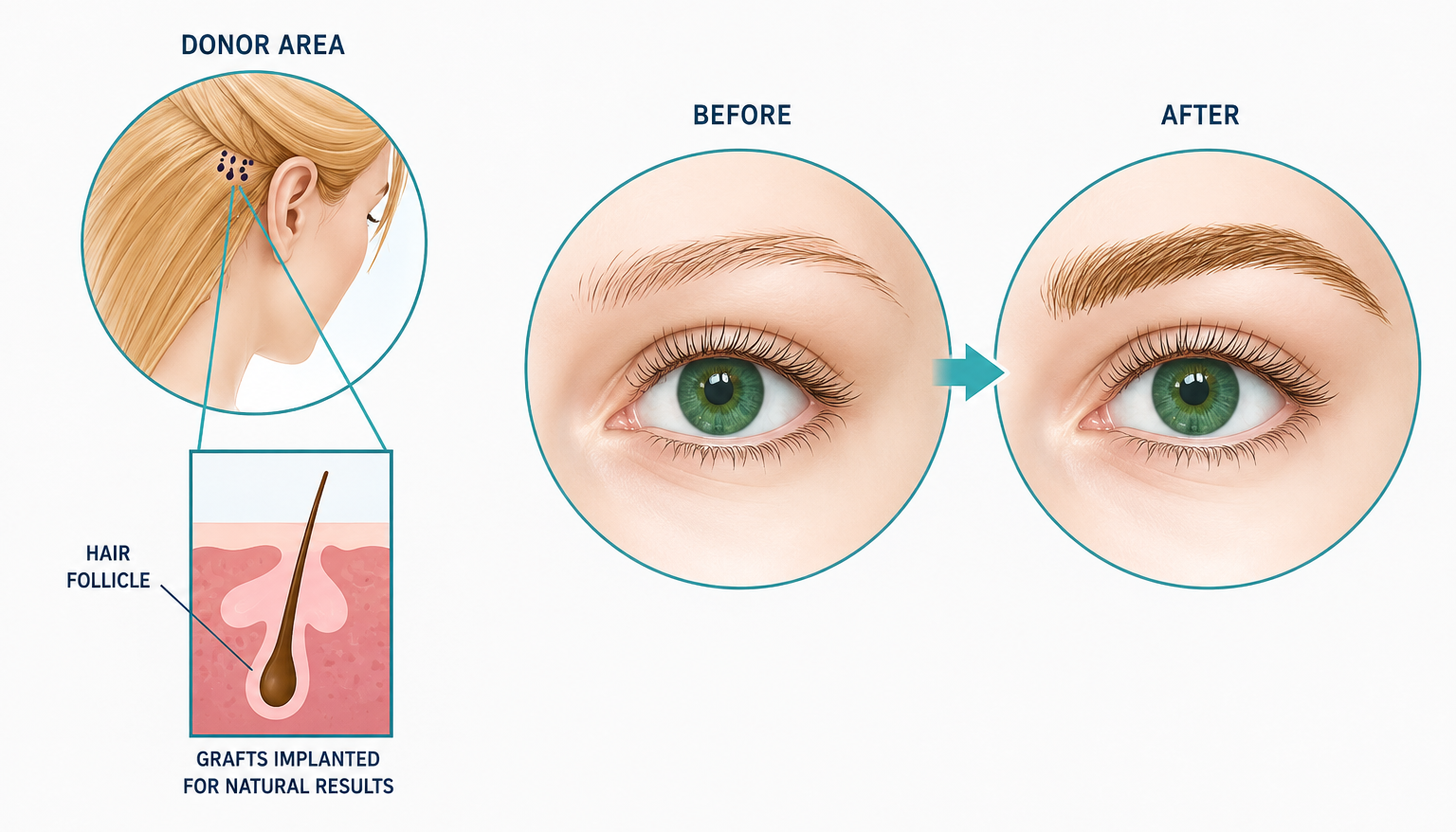
A specialized FUE procedure where individual hair follicles are extracted from the donor area and implanted into the eyebrows to restore or enhance shape, density, and definition.
Eyebrow Transplant
in Turkey
Eyebrow thinning can gradually affect confidence, appearance, and self-image over time. Eyebrow transplant has become one of the most effective solutions for patients seeking natural-looking and long-lasting results with restored facial framing and minimal visible scarring.
Turkey is recognized worldwide for advanced hair transplant procedures, experienced specialists, and modern medical facilities. CareBridge US helps international patients access trusted providers while guiding them through every step of the journey from consultation to recovery.
Eyebrow transplant using FUE (Follicular Unit Extraction) is commonly recommended for patients seeking fuller, naturally shaped brows with precise direction and angle control. The procedure involves extracting individual hair follicles from donor areas and implanting them into the eyebrow region following the natural growth pattern.
What is Eyebrow Transplant?
The eyebrow transplant is a specialized application of FUE hair restoration adapted specifically for the brow area. Surgeons perform the eyebrow transplant procedure by harvesting individual follicles from the donor area, typically the nape or peri-auricular region, and implanting them into the eyebrows to restore or enhance shape, density, and definition.
Unlike scalp transplantation, eyebrow restoration depends almost entirely on angle and direction. Scalp hair grows in relatively straight patterns. Eyebrow hair grows at sharp, flat angles and follows complex directional flows: upward near the nose, arching across the brow, and downward toward the temple. If placement ignores this, the result appears unnatural even when every graft survives.
The procedure is commonly used for:
-
over-plucked or damaged brows that no longer regrow
-
naturally thin or sparse eyebrow hair
-
scarring or trauma-related loss
-
asymmetry correction
-
desire for fuller shape or extended tail definition
Key elements of the technique:
-
Individual follicle extraction using microtools
-
Single-hair graft selection for natural density
-
Precise angle placement, usually 10 to 15 degrees
-
Directional control matching natural brow flow
-
Minimal visible scarring in donor and recipient areas
The donor area is the base of the whole result in an eyebrow transplant procedure. Its hair texture and density determine how natural the outcome appears. No medical method can alter the fundamental characteristics of the transplanted follicles once they are relocated.
Best Candidates for Eyebrow Transplant in Turkey
Suitability is not defined by desire alone but by biological conditions. The first factor evaluated is stability: Brow thinning or damage that has remained relatively unchanged for an extended period provides a predictable base for planning. Ongoing loss or active skin conditions introduce uncertainty.
The second factor is donor quality: Fine, single-hair follicles from the nape or behind the ears produce the most natural results. Coarse donor hair produces thick, unnatural-looking brows and may require ongoing trimming.
Scalp and skin condition also matter. Healthy skin supports graft survival, while inflammation, active infection, or dermatological disorders can reduce success rates.
Expectations must remain aligned with reality. An eyebrow transplant restores density and shape but does not replicate makeup-defined arches without careful design input. Grafts grow like scalp hair and may need periodic trimming.
Patients with trichotillomania should ensure the condition is fully controlled before considering surgery. Pulling transplanted grafts will destroy results.
Typical suitable profile:
-
stable brow thinning or loss pattern
-
fine donor hair available at the nape or behind ears
-
healthy scalp and brow skin
-
realistic expectations about texture and maintenance
-
no active skin conditions in the treatment area
Eyebrow Transplant Process in Turkey
The eyebrow transplant procedure in Turkey follows a clear medical process. It is usually completed in one day. Each step affects the final result, especially natural appearance and density.
Brow evaluation and graft planning: The process starts with an examination. The surgeon assesses the brow area and estimates the number of grafts. This step defines what is possible based on available donor hair and existing brow structure.
Brow design: The surgeon designs the brow shape while the patient is awake. Symmetry, arch placement, and tail definition are adjusted before the eyebrow transplant procedure begins.
Local anesthesia: Local anesthesia is applied to the donor and recipient areas. The eyebrow transplant operation is then performed without pain.
Follicle extraction: The surgeon removes follicles one by one from the donor area using small tools. This step is part of the eyebrow transplant procedure and protects the surrounding tissue.
Graft sorting: The extracted grafts are placed under magnification and sorted. Only single-hair units are selected. Multi-hair grafts are split or discarded because they create an unnatural clumped appearance in the brow.
Recipient area preparation: Tiny channels are created in the brow area. These guide the placement, angle, and direction of the new hair.
Graft implantation: Each graft is implanted one by one using fine needles or implanter pens. The angle and direction are controlled to match natural eyebrow hair growth.
Hair Loss Treatments
Get In Touch With Us
Call Us Anytime
+1 929 7101 505
+90 537 462 26 09
+90 537 462 26 09
Email Us
contact@carebridgeus.com
Book A Free Consultation
Request your free consultation with CareBridge US by filling out the form below. Our team will contact you to discuss your treatment goals and guide you through your medical journey in Turkey.
Eyebrow Transplant Recovery
Recovery follows a predictable biological cycle rather than a linear improvement.
In the first days, tiny crusts form around each implanted graft. These must not be picked. This phase is temporary and usually resolves within 7 to 10 days.
Redness and mild swelling in the forehead and brow area are common during the first week.
A shedding phase follows during weeks 3 to 4. Transplanted hairs fall out as follicles enter a resting phase beneath the skin. This is expected and does not indicate failure.
Growth begins gradually between month 3 and 4. Initial hair may appear finer or slightly curlier than native brows. Density increases over time.
Recovery timeline:
Day 1 to 14: healing phase, crust shedding
Week 3 to 4: shedding phase
Month 3 to 4: early regrowth
Month 6: visible density improvement
Month 9 to 12: final result
Transplanted hair retains scalp characteristics. It grows faster and longer than native eyebrow hair. Regular trimming, typically every 2 to 4 weeks, is necessary to maintain shape.
In the first days, tiny crusts form around each implanted graft. These must not be picked. This phase is temporary and usually resolves within 7 to 10 days.
Redness and mild swelling in the forehead and brow area are common during the first week.
A shedding phase follows during weeks 3 to 4. Transplanted hairs fall out as follicles enter a resting phase beneath the skin. This is expected and does not indicate failure.
Growth begins gradually between month 3 and 4. Initial hair may appear finer or slightly curlier than native brows. Density increases over time.
Recovery timeline:
Day 1 to 14: healing phase, crust shedding
Week 3 to 4: shedding phase
Month 3 to 4: early regrowth
Month 6: visible density improvement
Month 9 to 12: final result
Transplanted hair retains scalp characteristics. It grows faster and longer than native eyebrow hair. Regular trimming, typically every 2 to 4 weeks, is necessary to maintain shape.
Preparation for Eyebrow Transplant
Preparation directly influences graft survival and recovery quality. In the week before the procedure, smoking and alcohol are typically discontinued to support circulation. Any medication affecting blood flow is reviewed under medical supervision.
The scalp and brow area are cleansed the day before using specific antiseptic products. On the day of the procedure, no makeup, creams, or styling products are used.
Preparation checklist:
-
Stop smoking and alcohol
-
Review medications with physician
-
Clean donor area and brows before procedure
-
Avoid brow plucking or waxing for several weeks prior
Post-procedure positioning during sleep is also important, especially in the first nights when graft stability is most sensitive. Sleeping with the head elevated reduces swelling.
Risks and Limitations of Eyebrow Transplant
The eyebrow transplant is considered safe in controlled medical environments, but it is not without limitations.
Temporary effects may include swelling, redness, and tenderness in both donor and recipient areas. These are part of the normal healing cycle.
More structural limitations define long-term results. The number of grafts is fixed by donor supply. Poor angle placement can produce unnatural direction. Transplanted hair requires ongoing trimming because it retains scalp growth characteristics.
Key limitations:
-
Limited donor supply of fine single-hair follicles
-
Transplanted hair texture differs from native brow hair
-
Ongoing trimming required for maintenance
-
Micro scarring in donor area
-
Early uneven growth before stabilization
Outcome quality depends more on surgical precision and donor hair quality than on volume alone. A small number of perfectly placed grafts looks better than a large number placed at incorrect angles.
Before & After
Results
Eyebrow transplant helps restore natural brow density and improve facial balance using carefully placed hair grafts. Before treatment, brows may appear thin, uneven, patchy, or shortened, often requiring makeup or microblading for definition.
During healing, small crusts and mild swelling can appear temporarily around the brow area. New hairs usually begin growing between months 3 and 6, with final results visible around 9 to 12 months.
Because donor hair comes from the scalp, transplanted brows may grow longer and thicker than natural brow hair, making regular trimming necessary. The goal is a natural, subtle restoration that enhances facial harmony while maintaining realistic density and shape.
![CareBridge - Eyebrow Transplant - Before and after [04]](https://carebridgeus.com/wp-content/uploads/2026/05/CareBridge-Eyebrow-Transplant-Before-and-after-04.jpg "CareBridge - Eyebrow Transplant - Before and after [04]")
![CareBridge - Eyebrow Transplant - Before and after [03]](https://carebridgeus.com/wp-content/uploads/2026/05/CareBridge-Eyebrow-Transplant-Before-and-after-03.jpg "CareBridge - Eyebrow Transplant - Before and after [03]")
![CareBridge - Eyebrow Transplant - Before and after [02]](https://carebridgeus.com/wp-content/uploads/2026/05/CareBridge-Eyebrow-Transplant-Before-and-after-02.jpg "CareBridge - Eyebrow Transplant - Before and after [02]")
![CareBridge - Eyebrow Transplant - Before and after [01]](https://carebridgeus.com/wp-content/uploads/2026/05/CareBridge-Eyebrow-Transplant-Before-and-after-01.jpg "CareBridge - Eyebrow Transplant - Before and after [01]")
What is an eyebrow transplant?
How many grafts do I need?
Most patients require between 200 and 400 grafts per brow, totaling 400 to 800 grafts for both eyebrows. The exact number depends on existing density, desired shape, and the degree of thinning or scarring.
When will my transplanted eyebrows grow?
Initial shedding occurs around weeks 3 to 4. New growth begins around month 3 to 4. Visible density improves by month 6, and final results stabilize between month 9 and 12.
Is the result permanent?
Yes. The transplanted follicles are taken from areas genetically resistant to hair loss. Once they establish blood supply and survive the initial healing period, they continue to grow permanently. However, surrounding native brow hair may continue to thin over time depending on underlying causes.
Do I need to trim my eyebrows after the transplant?
Yes. Transplanted hair comes from the scalp and retains scalp growth characteristics. It grows longer and faster than native brow hair. Most patients trim their brows every 2 to 4 weeks.
What is shock loss?
Shock loss refers to the temporary shedding of transplanted hairs during weeks 3 to 4 after the procedure. The follicles enter a resting phase beneath the skin before new growth begins. This is expected and does not indicate failure.
Will there be visible scarring?
Donor area scarring consists of tiny white dots that are easily concealed by surrounding hair. The eyebrow recipient area does not scar visibly when implantation is performed correctly. No linear scar is created because FUE is used.
Get Your
Free Consultation
Speak With
A Medical
Consultant
Fill out the form and our team will contact you with personalized guidance and treatment information.
Copyright 2026 by Carebridge US. All rights reserved.
Copyright 2026 by Carebridge US. All rights reserved.